Question icon
Grade 10Mechanics

In a square field of side 10m, we move along two adjacent sides starting from one corner and ending at the opposite corner. What is our displacement.

Profile image of Jayati Dinesh Bharadwaj
15 Years agoGrade 10
Answers icon

4 Answers

Profile image of SAGAR SINGH - IIT DELHI
15 Years ago

Dear studentm

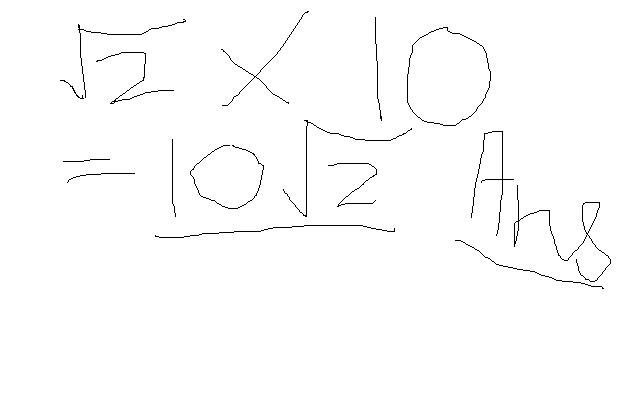
Displacement in this case= diagonal of the square=10 root 2 m

Please feel free to ask your queries here. We are all IITians and here to help you in your IIT JEE preparation.

All the best.

Win exciting gifts by answering the questions on Discussion Forum. So help discuss any query on askiitians forum and become an Elite Expert League askiitian.

Now you score 5+15 POINTS by uploading your Pic and Downloading the Askiitians Toolbar  respectively : Click here to download the toolbar..


Askiitians Expert

Sagar Singh

B.Tech, IIT Delhi

sagarsingh24.iitd@gmail.com

Profile image of vikas askiitian expert
15 Years ago

let abcd be a square ...

if we from vertex a move along two adjecent sides then finally we reach to vertex c (the opposite vertex) ...

from pythogorus theorem

 (ab)2+(bc)2 = (ac)2

ac is the displacement  , ab = ac = 10          (each side is equal )

 ac = root((ab)2+(bc)2)=(100+100)1/2

                                 =(200)1/2m

(200)1/2 m is displacement

Profile image of Shivam Bhagat
15 Years ago

Let one side to be x

displacement = the minimum possible distance between 2 points of movement

therefore in a square according to problem, the displacement is the diagonal of that square


1667_25367_ph3.jpg

Profile image of Fawz  Naim
15 Years ago

displacement is the distance between the initial and the final point. As we started from one vertex and stopped at the opposite vertex, so the displacement is equal to the length of the diagonal. Side of the square is 10m

therefore the length of the diagonal is =10*square root(2)

10*1.414=14.4m