
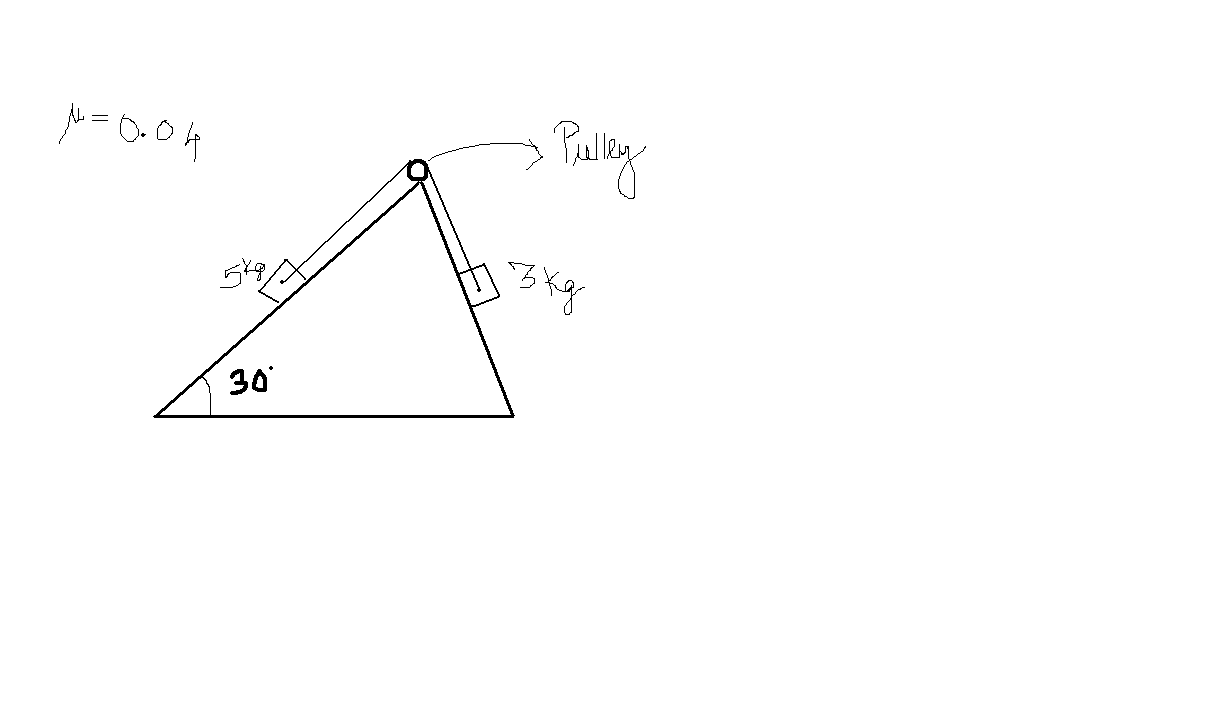
Calculate the friction, acceleration and tension for the system given in the figure

Nitin Gupta , 15 Years ago
Grade 11
 Mechanics> Please answer...
Calculate the friction, acceleration and tension for the system given in the figure
 1 Answers
To calculate the friction, acceleration, and tension in a system, we first need to understand the forces acting on the objects involved. Let's assume we have a simple system consisting of two blocks connected by a rope over a pulley, with one block on a surface and the other hanging off the edge. For this explanation, I will outline the steps to find the required values, using a hypothetical scenario for clarity.
Let’s define the components of our system:
We start by calculating the forces acting on each block:
The forces acting on Block A include:
The forces acting on Block B include:
Now, we can set up the equations based on Newton's second law, \( F = m \cdot a \).
The net force acting on Block A can be expressed as:
Net Force (Block A): \( T - f = m_A \cdot a \)
Substituting the frictional force:
Equation 1: \( T - \mu \cdot m_A \cdot g = m_A \cdot a \)
The net force acting on Block B is given by:
Net Force (Block B): \( m_B \cdot g - T = m_B \cdot a \)
Equation 2: \( m_B \cdot g - T = m_B \cdot a \)
Now we have two equations with two unknowns: tension \( T \) and acceleration \( a \). We can solve these equations simultaneously.
From Equation 1, we can express \( T \) as:
Equation 3: \( T = m_A \cdot a + \mu \cdot m_A \cdot g \)
Now, substitute Equation 3 into Equation 2:
Equation 4: \( m_B \cdot g - (m_A \cdot a + \mu \cdot m_A \cdot g) = m_B \cdot a \)
Rearranging gives us:
Equation 5: \( m_B \cdot g - \mu \cdot m_A \cdot g = (m_A + m_B) \cdot a \)
Now, we can solve for \( a \):
Acceleration: \( a = \frac{m_B \cdot g - \mu \cdot m_A \cdot g}{m_A + m_B} \)
Once we have the acceleration, we can substitute it back into Equation 3 to find the tension:
Tension: \( T = m_A \cdot a + \mu \cdot m_A \cdot g \)
The frictional force can be calculated using the coefficient of friction and the normal force:
Friction: \( f = \mu \cdot m_A \cdot g \)
Let’s say we have:
Substituting these values into our equations will yield the specific values for friction, acceleration, and tension.
By following these steps, you can systematically analyze and solve for the friction, acceleration, and tension in various systems. Each step builds on the previous one, ensuring a comprehensive understanding of the forces at play.
 Approved
Prepraring for the competition made easy just by live online class.

Full Live Access

Study Material

Live Doubts Solving

Daily Class Assignments

Three identical balls are placed on a frictionless
horizontal surface touching each other. They stick to
each other because of adhesive. Another ball of same
radius and mass m is placed over the void created by
the three balls. Find the forces applied by the balls
kept on the floor to each other if the system remains
in equilibrium.
Last Activity: 6 Months ago
A car loaded with water having total mass 1000 kg moves on a straight horizontal Road starting from rest under the action of a force of 100 Newton. The water spills throw a small hole in the bottom at a rate of 0.1 KG per second the velocity of cart after 300 seconds is nearly.
11
21
31
41
Last Activity: 6 Months ago
Last Activity: 3 Years ago
Last Activity: 3 Years ago
Last Activity: 3 Years ago