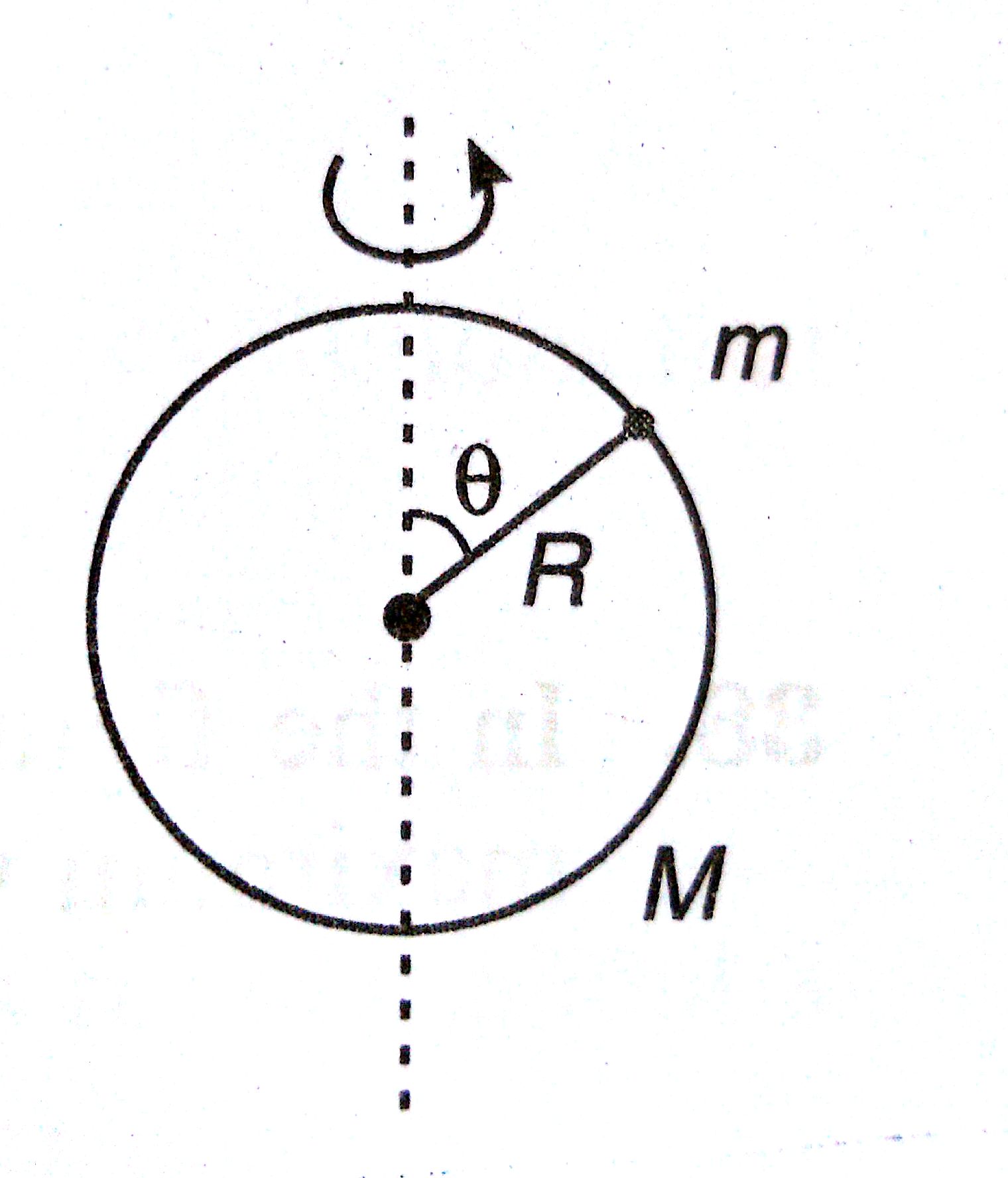
To solve this problem, we need to apply the principles of conservation of angular momentum and the dynamics of rotational motion. The system consists of a ring and a bead that can slide along the ring. Initially, the bead is at the top of the ring, and we want to find the angular velocity when the bead has moved halfway down to an angle of 45 degrees.
Understanding the System
We start with a ring of mass M = 1 kg and radius R = 0.4 m, which has a moment of inertia given by the formula:
I = (1/2)MR²
Substituting the values, we find:
I = (1/2)(1 kg)(0.4 m)² = 0.08 kg·m²
Initial Conditions
The bead has a mass m = 0.2 kg and is initially at the top of the ring. The angular velocity at this point is ω₁ = 5 rad/s. The total moment of inertia of the system when the bead is at the top can be calculated as follows:
- Moment of inertia of the ring: I_ring = 0.08 kg·m²
- Moment of inertia of the bead at the top (distance R from the axis): I_bead_top = mR² = (0.2 kg)(0.4 m)² = 0.016 kg·m²
The total moment of inertia when the bead is at the top is:
I_total_initial = I_ring + I_bead_top = 0.08 kg·m² + 0.016 kg·m² = 0.096 kg·m²
Angular Momentum Conservation
Angular momentum must be conserved in this system since there are no external torques acting on it. Therefore, we can set up the equation:
I_total_initial × ω₁ = I_total_final × ω₂
Where ω₂ is the angular velocity when the bead is at an angle of 45 degrees. Now, we need to calculate the moment of inertia when the bead is halfway down the ring.
Calculating the New Moment of Inertia
When the bead is at an angle of 45 degrees, its distance from the axis of rotation can be calculated using trigonometry:
r = R × cos(45°) = 0.4 m × (1/√2) ≈ 0.283 m
The moment of inertia of the bead at this position is:
I_bead_45 = m × r² = (0.2 kg)(0.283 m)² ≈ 0.016 kg·m²
The total moment of inertia when the bead is at 45 degrees is:
I_total_final = I_ring + I_bead_45 = 0.08 kg·m² + 0.016 kg·m² = 0.096 kg·m²
Solving for the Final Angular Velocity
Now we can substitute the values into the conservation of angular momentum equation:
0.096 kg·m² × 5 rad/s = 0.096 kg·m² × ω₂
Since the moment of inertia is the same in both cases, we can simplify this to:
5 rad/s = ω₂
Final Thoughts
Interestingly, the angular velocity remains constant at 5 rad/s even when the bead moves to the halfway point at 45 degrees. This is due to the fact that the total moment of inertia of the system does not change as the bead slides along the ring. Therefore, the angular velocity of the system remains unchanged.