Question icon
Inorganic Chemistry

Bragg`s law

Profile image of sakshi jain
12 Years agoGrade
Answers icon

4 Answers

Profile image of Vasantha Kumari
12 Years ago

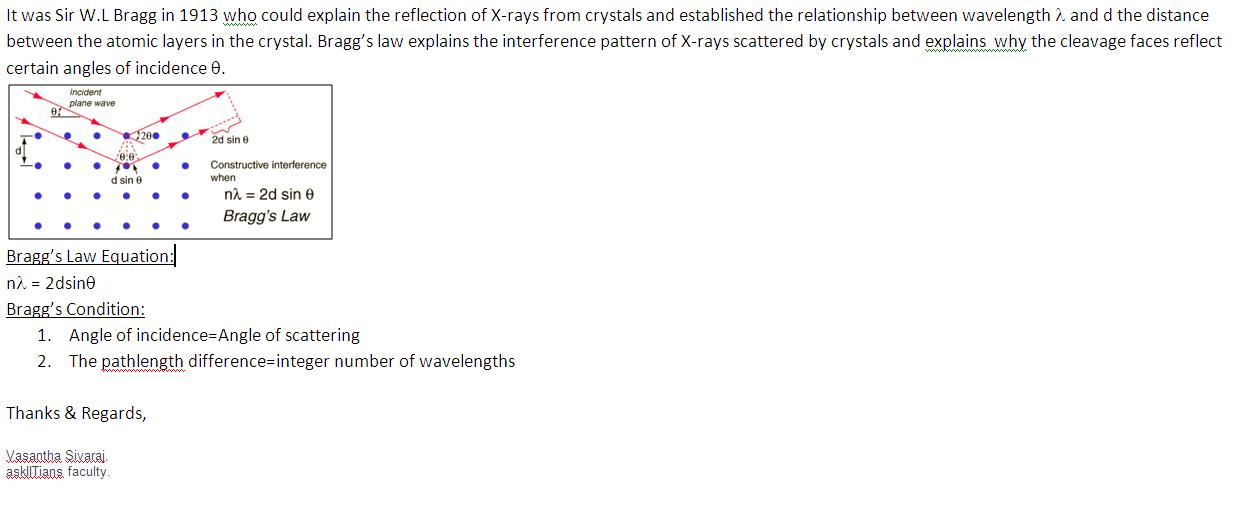
181-303_bragg.JPG
Profile image of Nirmal Singh.
12 Years ago
the principle that when a beam of X-rays of wavelength ? enters a crystal, the maximum intensity of the reflected ray occurs when sin ? = n?/2d, where ? is the complement of the angle of incidence, n is a whole number, and d is the distance between layers of atoms..

Bragg's Law refers to the simple equation:

n? = 2d sinT

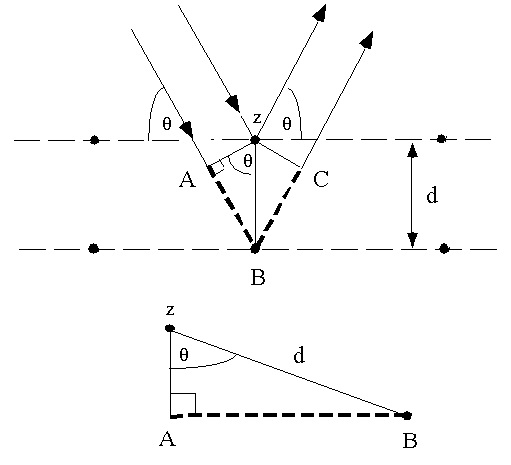
derived by the English physicists Sir W.H. Bragg and his son Sir W.L. Bragg in 1913 to explain why the cleavage faces of crystals appear to reflect X-ray beams at certain angles of incidence (T, ?). The variable d is the distance between atomic layers in a crystal, and the variable lambda is the wavelength of the incident X-ray beam (see applet); n is an integer.
201-2402_BraggDeriv.jpg
Regards,
Nirmal Singh
Askliitians Faculty
Profile image of BAYANA SAGAR
12 Years ago
Bragg`s proposed a equation to gave a relationship between the wavelength of x-rays(lambda)and distance(d) and the angle of diffraction.
Profile image of chevvakula tulasi
12 Years ago
braags equation n*lamda= 2d sin (teta)