

Grade 11IIT JEE Entrance Exam
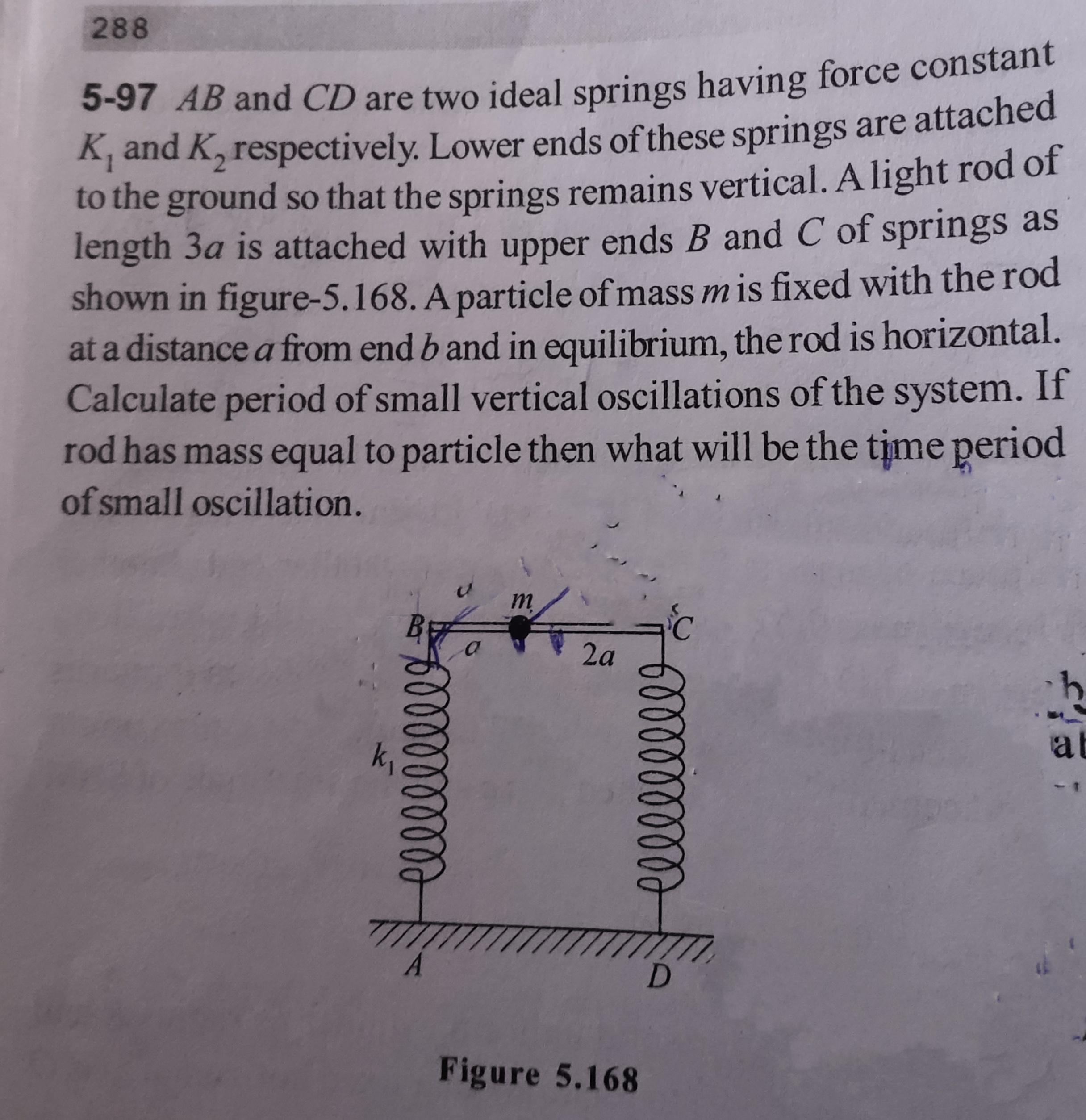
Can anyone please provide me the solution of this question based on shm
Can anyone please provide me the solution of this question based on shm


 Approved Tutor Answer1 Year ago
To tackle a question related to simple harmonic motion (SHM), it’s essential to first understand the fundamental concepts that govern this type of motion. SHM describes the oscillatory motion of an object where the restoring force is directly proportional to the displacement from its equilibrium position and acts in the opposite direction. Let’s break down the key elements and then apply them to a specific problem.
In SHM, several important parameters come into play:
Let’s consider a common SHM problem: A mass attached to a spring oscillates with an amplitude of 0.2 m and a spring constant of 50 N/m. We want to find the period of the motion.
1. **Identify the parameters**: We have the amplitude (A = 0.2 m) and the spring constant (k = 50 N/m).
2. **Calculate the mass (m)**: To find the period, we need the mass of the object. If the mass is not given, we can express the period in terms of m. The formula for the period of a mass-spring system is:
T = 2π√(m/k)
3. **Substitute the values**: If we assume a mass of 2 kg for this example, we can substitute it into the formula:
T = 2π√(2 kg / 50 N/m)
4. **Calculate**: Now, let’s compute the value:
T = 2π√(0.04) = 2π(0.2) ≈ 1.2566 seconds
This means that the mass will take approximately 1.26 seconds to complete one full cycle of oscillation. The period is a crucial aspect of SHM as it tells us how quickly the oscillations occur.
In summary, when solving SHM problems, always start by identifying the known parameters and use the appropriate formulas. This structured approach not only helps in finding the solution but also deepens your understanding of the underlying physics. If you have a specific SHM question in mind, feel free to share it, and we can work through it together!

Let S={x:x belongs to R(√3+√2)^(x^2-4) - (√3-√2)^(x^2-4)=10}. Then n(S) is equal to-
Last Activity: 10 Months ago
Last Activity: 3 Years ago
Last Activity: 4 Years ago
Last Activity: 4 Years ago