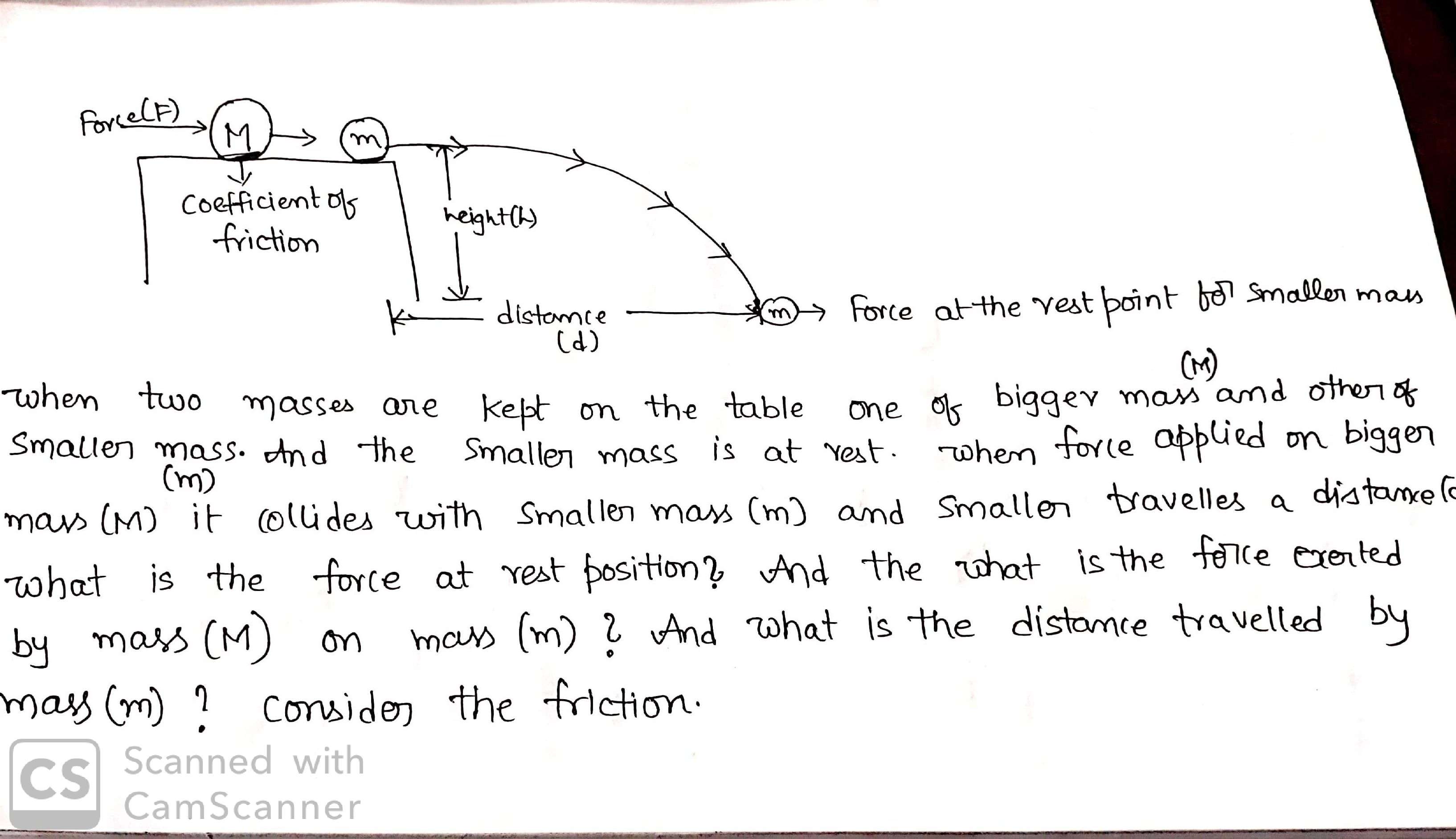
When two masses collide, the dynamics of the situation can be quite fascinating. Let's break down what happens when a larger mass collides with a smaller mass, particularly focusing on the motion of the smaller mass after the collision. We’ll explore the concepts of linear motion, trajectory, distance traveled, and velocity at various points along the path.
Understanding the Collision
Imagine you have a large block (the bigger mass) and a small ball (the smaller mass) resting on a table. When the larger block collides with the smaller ball, several factors come into play, including the forces exerted during the collision and the resulting motion of the smaller mass.
Initial Conditions
Before the collision, both masses are at rest. When the larger mass moves and strikes the smaller mass, it transfers some of its momentum to the smaller mass. The outcome depends on the masses involved and the speed of the larger mass at the moment of impact.
Linear Motion After Collision
Immediately after the collision, the smaller mass will begin to move in a linear path. This motion can be described using Newton's laws of motion. If we assume the collision is elastic (where kinetic energy is conserved), the smaller mass will move away from the point of impact with a certain velocity.
- Velocity Calculation: The velocity of the smaller mass after the collision can be calculated using the conservation of momentum formula:
- m1 * v1 + m2 * v2 = m1 * v1' + m2 * v2'
- Where m1 and m2 are the masses, v1 and v2 are the initial velocities, and v1' and v2' are the final velocities after the collision.
Trajectory Path
Once the smaller mass leaves the edge of the table, it will follow a projectile motion path due to the influence of gravity. The trajectory can be analyzed in two components: horizontal and vertical.
Horizontal Motion
The horizontal motion of the smaller mass remains constant (assuming no air resistance) because there are no horizontal forces acting on it after it leaves the table. The distance traveled horizontally can be calculated using:
- Distance: d = v_horizontal * t
Vertical Motion
In the vertical direction, the smaller mass will accelerate downward due to gravity. The distance fallen can be calculated using the equation:
- Distance Fallen: h = 0.5 * g * t²
- Where g is the acceleration due to gravity (approximately 9.81 m/s²) and t is the time taken to fall.
Velocity at Each Point
The velocity of the smaller mass changes as it moves along its trajectory. Initially, it has a horizontal velocity (v_horizontal) and a vertical velocity that increases as it falls. The total velocity at any point can be found using the Pythagorean theorem:
- Total Velocity: v_total = √(v_horizontal² + v_vertical²)
As the smaller mass falls, its vertical velocity increases due to gravity, while the horizontal velocity remains constant. This means that at the moment it leaves the table, its total velocity is just its horizontal velocity, but as it falls, the vertical component increases until it reaches the ground.
Putting It All Together
In summary, when the larger mass collides with the smaller mass, the smaller mass will initially move in a linear path and then follow a projectile trajectory once it leaves the table. The distance traveled and the velocity at various points can be calculated using the principles of physics, specifically the conservation of momentum for the collision and kinematic equations for the motion after the collision. This interplay of forces and motion beautifully illustrates the principles of classical mechanics in action.