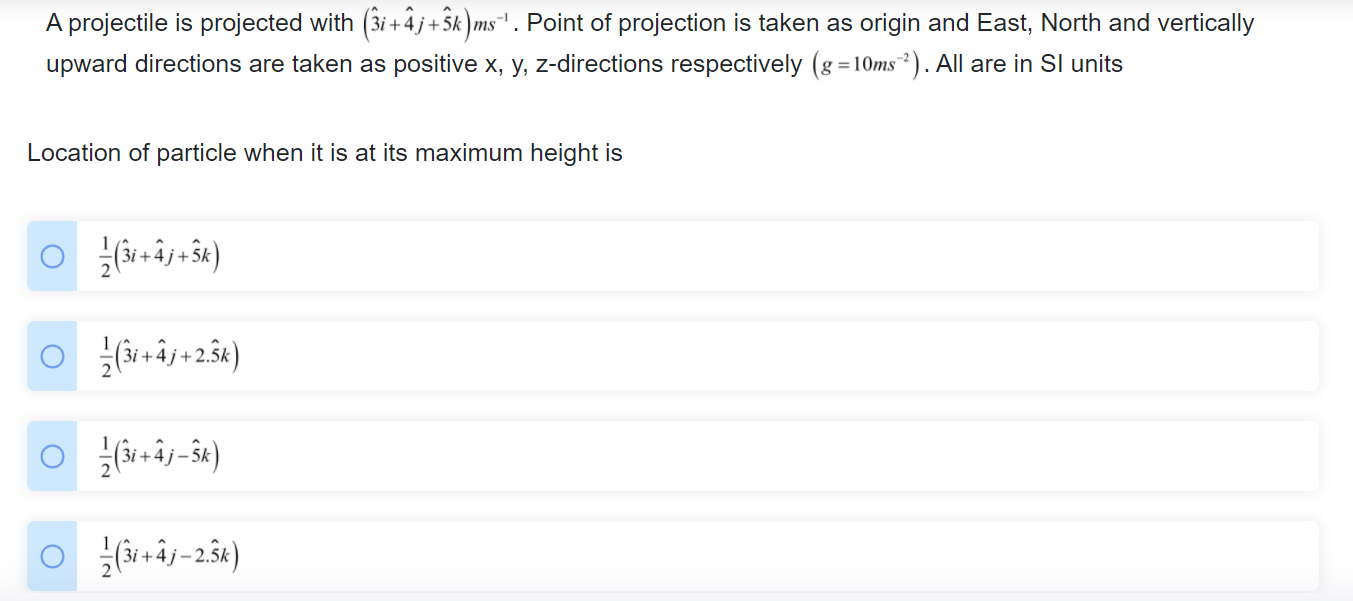
To understand the motion of a projectile projected with the vector \( \mathbf{v} = 3\hat{i} + 4\hat{j} + 5\hat{k} \), we need to break down what this vector represents and how it relates to the projectile's trajectory. The components of the vector indicate the initial velocity in three-dimensional space, where \( \hat{i} \), \( \hat{j} \), and \( \hat{k} \) represent the x, y, and z axes, respectively.
Breaking Down the Components
The vector \( \mathbf{v} = 3\hat{i} + 4\hat{j} + 5\hat{k} \) can be interpreted as follows:
- 3 units in the x-direction: This means the projectile has an initial velocity of 3 units along the horizontal axis.
- 4 units in the y-direction: This indicates an upward velocity of 4 units, contributing to the projectile's height.
- 5 units in the z-direction: This component suggests that the projectile is also moving in the vertical direction, which could represent height or depth depending on the context.
Understanding Projectile Motion
In projectile motion, the path followed by the object is typically a parabola when considering only two dimensions (x and y). However, since we have a three-dimensional vector, we can visualize the motion in a more complex space. The motion can be analyzed in terms of its horizontal and vertical components:
- Horizontal Motion (x and y components): The projectile will move forward in the x-direction while simultaneously rising in the y-direction.
- Vertical Motion (z component): The z component adds another layer, indicating that the projectile is also moving vertically, which could be influenced by gravity if we consider it in a gravitational field.
Equations of Motion
To analyze the projectile's motion further, we can use the equations of motion. The basic equations for projectile motion in three dimensions can be expressed as:
- Position in x: \( x(t) = x_0 + v_{x} t \)
- Position in y: \( y(t) = y_0 + v_{y} t - \frac{1}{2} g t^2 \)
- Position in z: \( z(t) = z_0 + v_{z} t \)
Here, \( v_{x} \), \( v_{y} \), and \( v_{z} \) are the components of the initial velocity, \( g \) is the acceleration due to gravity (approximately \( 9.81 \, \text{m/s}^2 \) downward), and \( t \) is the time elapsed since the projectile was launched. The initial positions \( x_0 \), \( y_0 \), and \( z_0 \) are typically set to zero if we consider the launch point as the origin.
Example Calculation
Let’s say we want to find the position of the projectile after 2 seconds. Assuming it was launched from the origin (0, 0, 0), we can plug in the values:
- For x: \( x(2) = 0 + 3 \cdot 2 = 6 \)
- For y: \( y(2) = 0 + 4 \cdot 2 - \frac{1}{2} \cdot 9.81 \cdot (2^2) = 8 - 19.62 = -11.62 \) (indicating it has fallen below the launch height)
- For z: \( z(2) = 0 + 5 \cdot 2 = 10 \)
After 2 seconds, the projectile would be at the position \( (6, -11.62, 10) \). This shows how the projectile moves in three dimensions, influenced by its initial velocity and the effects of gravity on the vertical motion.
Final Thoughts
In summary, the initial velocity vector \( \mathbf{v} = 3\hat{i} + 4\hat{j} + 5\hat{k} \) provides a comprehensive view of the projectile's motion in three-dimensional space. By analyzing the components and applying the equations of motion, we can predict the projectile's trajectory and position at any given time. If you have any further questions or need clarification on specific aspects, feel free to ask!