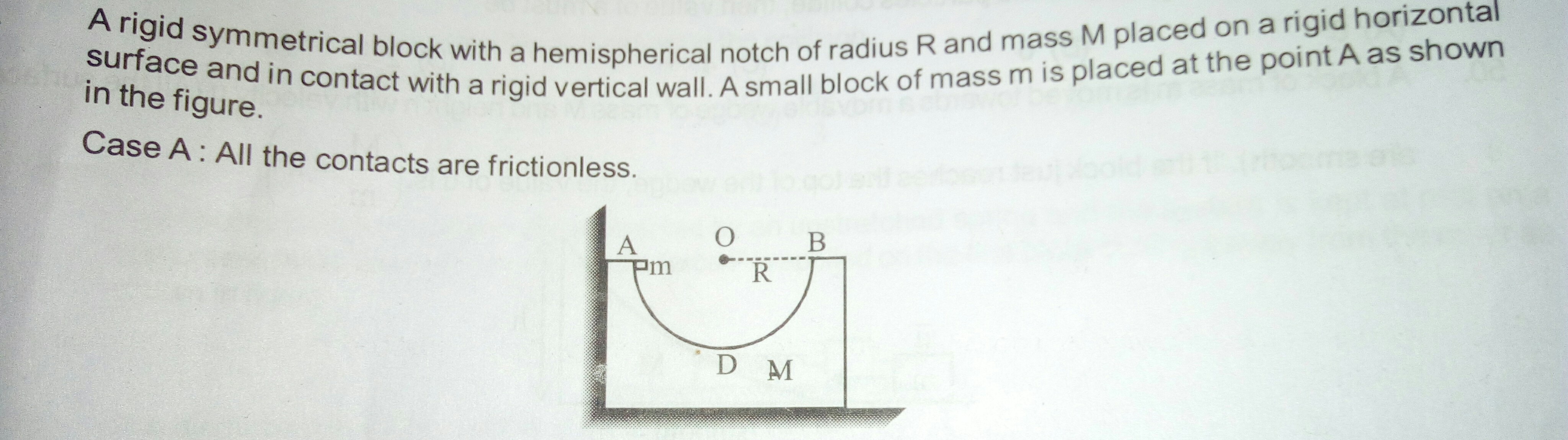
To determine the contact force on the block of mass M exerted by the horizontal surface, we need to analyze the forces acting on the system, particularly focusing on the geometry of the situation and the angles involved. Let's break this down step by step.
Understanding the Forces at Play
In this scenario, we have two masses: a block of mass M resting on a horizontal surface and another block of mass m connected to it, which is positioned at a hemispherical notch. The line joining the block of mass m to the center of the hemispherical notch makes an angle of 30 degrees with the radius OA.
Identifying the Forces
First, let's identify the forces acting on the block of mass M:
- Weight of the block (W): This is the gravitational force acting downwards, given by W = Mg, where g is the acceleration due to gravity.
- Normal Force (N): This is the contact force exerted by the surface on the block, acting perpendicular to the surface.
- Force due to block m: The block m exerts a force on block M due to its weight and the angle at which it is positioned.
Calculating the Forces
Since the block m is connected to the block M and is positioned at an angle of 30 degrees, we can analyze the vertical and horizontal components of the forces. The weight of block m contributes to the force exerted on block M.
The vertical component of the force exerted by block m can be calculated as:
Vertical Force (Fv) = mg * cos(30°)
Similarly, the horizontal component can be calculated as:
Horizontal Force (Fh) = mg * sin(30°)
Net Force on Block M
Now, considering the equilibrium of forces acting on block M, the normal force N must balance out the weight of block M and the vertical component of the force from block m:
N = Mg + Fv
Substituting the expression for Fv:
N = Mg + mg * cos(30°)
Calculating the Cosine of 30 Degrees
We know that cos(30°) = √3/2. Therefore, we can rewrite the normal force as:
N = Mg + mg * (√3/2)
Final Expression for Contact Force
To find the total contact force, we need to consider both the weight of block M and the contribution from block m:
N = Mg + mg * (√3/2)
Now, let's evaluate the options provided:
- (A) mg + Mg
- (B) 1.5mg + Mg
- (C) 0.75mg + Mg
- (D) None of these
Given that we have derived the expression for the normal force, we can see that it does not match any of the options directly. Therefore, the correct answer is:
(D) None of these
Summary
In summary, the contact force on the block of mass M is influenced by both its weight and the vertical component of the force exerted by block m. After careful analysis, we concluded that the expression does not match any of the provided options, leading us to select "none of these." This illustrates the importance of breaking down forces and understanding their components in physics problems.