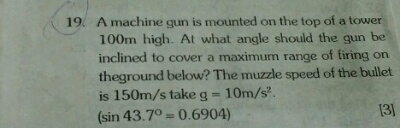
Here,
u = 150 ms-1
And, Taking g = 10 m-2 (approximately)
Let 'θ' be the angle at which the machine gun should fire in order to cover a maximum distance.
Then , the horizontal component of velocity = 150 cos θ
And, the vertical component of velocity = 150 sin θ
If 'T' is the time of flight, then ,
Horizontal range, R = (150 cos θ ) x T .
The gun is mounted at the top of a tower 100 meters high .
Let us regard the positive direction of the position-axis as to be along the line from the top of tower in downward direction.
For motion along vertical :
Initial Velocity = -150 sin θ;
Distance covered = + 100 m
And, acceleration = + 10 ms-2
In time 'T' , the machine gun shot will reach maximum height and then reach the ground.
Now,
S = ut + 1/2 at2
Therefore, +100 = ( -150 sin θ ) T + 1/2 x T2
Or, T2 - ( 30 sin θ )T - 20 = 0
Therefore, T = - ( - 30 sin θ ) ± { ( - 30 sin θ)2 - 4 x 1 x (-20) }1/2/2
= 30 sin θ ± (900 sin2 θ + 80 )1/2/2
Or, T = 15 sinθ ± (225 sin2θ + 20)1/2
Now, range will be maximum, if time of flight is maximum .
Therefore, choosing positive sign ,we have
T = 15 sin θ + ( 225 sin2θ+ 20 )1/2
Hence, horizontal range covered,
R = 150 cos θ {15 sin θ+ ( 225 sin2θ + 20 )}1/2
The horizontal range is maximum, when θ = 45o.
But in the present case , the machine gun is mounted at height of 100 m .
Therefore, R will not be maximum for θ = 45o.It will be maximum for some value of θ close to 45o.
If we calculate values of R by setting θ = 43o, 43.5o, 44o, 45o, 46o and 47o, the values of R come out to be 2347 m, 2347.7 m, 2348 m, 2346 m, 2341 m and 2334 m respectively.
Thus R is maximum for value of θ some where between 43.5o and 44o.
Therefore , the mean value of θ = (43.5o + 44o)/2 = 43.75o.
The gun should be inclined at 43.75o to cover a maximum range of firing on the ground below.