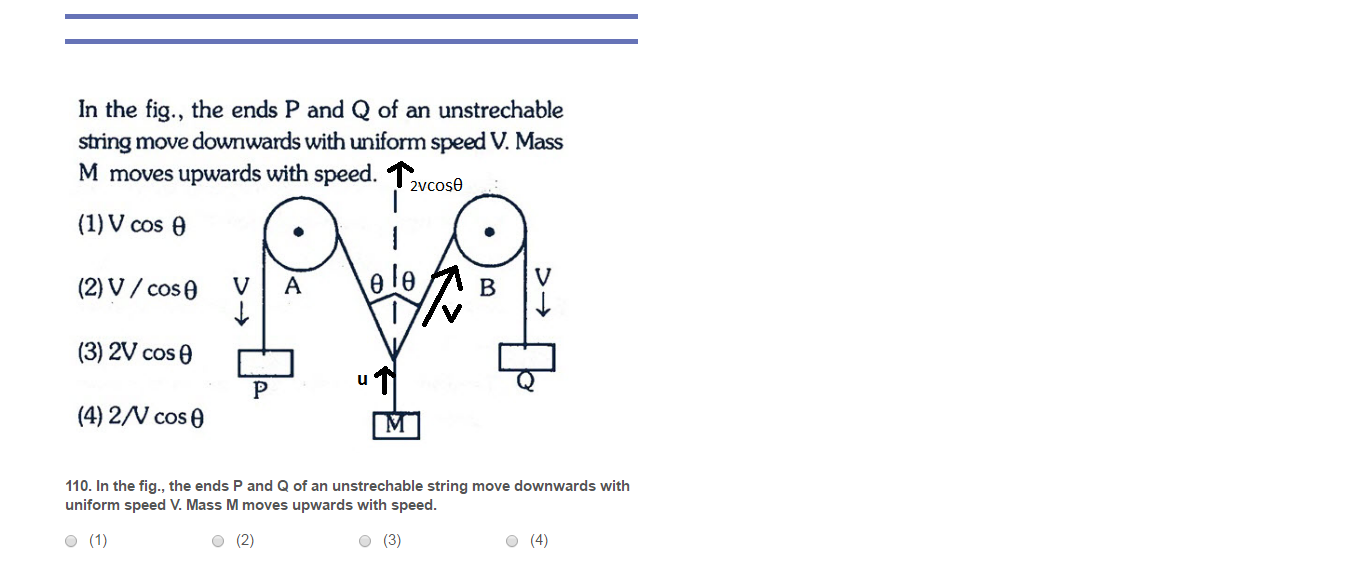
To understand why the relationship between the upward velocity \( u \) of the mass and the velocity \( v \) resolved into \( v \cos \theta \) leads to the equation \( u = \frac{v}{\cos \theta} \), we need to break down the mechanics of the system involving pulleys and the angles involved.
Analyzing the System
In a typical pulley system, when a mass is lifted, the motion of the rope and the angles at which it is pulled play a crucial role in determining the velocities involved. Let's consider a scenario where a mass is being lifted by a rope that passes over two pulleys, creating an angle \( \theta \) with the vertical.
Understanding Velocity Components
When we talk about the velocity \( v \) of the rope, it can be resolved into two components: one that acts vertically (upward) and one that acts horizontally. The vertical component of the velocity can be expressed as:
- Vertical Component: \( v \cos \theta \)
- Horizontal Component: \( v \sin \theta \)
However, since we are primarily interested in the upward motion of the mass, we focus on the vertical component. The upward velocity of the mass \( u \) is directly related to how fast the rope is being pulled vertically.
Relating the Velocities
In a system with two pulleys, the relationship between the upward velocity \( u \) of the mass and the velocity \( v \) of the rope is not straightforward. When the rope is pulled, both segments of the rope contribute to lifting the mass. Therefore, if you pull the rope with velocity \( v \), the effective upward velocity of the mass is actually influenced by the angle of the rope.
For every unit of length the rope is pulled, the mass moves upward by a factor that depends on the angle \( \theta \). Specifically, if you pull the rope at an angle, the vertical distance covered by the mass is less than the distance pulled due to the cosine of the angle:
Thus, the relationship can be expressed as:
u = 2(v \cos \theta)
However, this is not the complete picture. The upward velocity \( u \) is actually derived from the total vertical movement contributed by both sides of the rope. Therefore, we can express this as:
u = v \cdot \frac{1}{\cos \theta}
Conclusion on the Relationship
To summarize, the upward velocity \( u \) of the mass is related to the pulling velocity \( v \) of the rope by the factor of \( \frac{1}{\cos \theta} \). This means that as the angle \( \theta \) increases, the effective upward velocity of the mass decreases, which is why we arrive at the equation:
u = \frac{v}{\cos \theta}
In practical terms, if you were to pull the rope at a steeper angle, you would need to pull it faster to achieve the same upward velocity for the mass. This relationship is crucial in understanding the dynamics of pulley systems and how angles affect motion.