

Grade 12General Physics
intensity of gravitational field where gravitational potential is constant
intensity of gravitational field where gravitational potential is constant


The space around a body where the gravitational force exerted by it can be experienced by any other particle is known as the gravitational field of the body. The strength of this gravitational field is referred to as intensity, and it varies from point to point.
Consider the gravitational field of a particle of mass m located at the origin (O).
Suppose that a test particle of mass m0 is placed at the point P(x, y, z). The force of gravitational attraction exerted on the test particle is given by,
 g = (GMmo/r2)
where the position vector  = r,
= r,
r = OP = || = | | = r
| = r
and the unit vector, = / r
The intensity of this gravitational field at a point (P) is given by the force per unit mass on a test particle kept at P, i.e.
 = g/mo
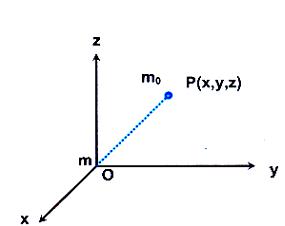
where is the gravitational intensity and g is the gravitational force acting on the mass m0. The gravitational field is, therefore, a vector field.
The gravitational field at P due to a particle of mass m kept at the point O (origin) is given by
= g/mo = {-(Gmmo/r2)} * 1/mo = Gm/r2
where = xi + yj + zk represents the position vector of the point P with respect to the source at the origin and = / r represents the unit vector along the radial direction.
The superposition principle extends to gravitational field (intensities) as well:
= 1 + 2 + 3 +....+ n
where1, 2,.... n are the gravitational field intensities at a point due to particle 1, 2, ......, n respectively.
For a continuously distributed mass, the formula changes to =∫d, where d gravitational field intensity due to an elementary mass dm.

In viewing through a magnifying glass, one usually positions one's eyes very close to the lens. Does angular magnification change if the eye is moved back?
Last Activity: 9 Months ago
Last Activity: 3 Years ago
Last Activity: 3 Years ago
Last Activity: 3 Years ago
Last Activity: 3 Years ago