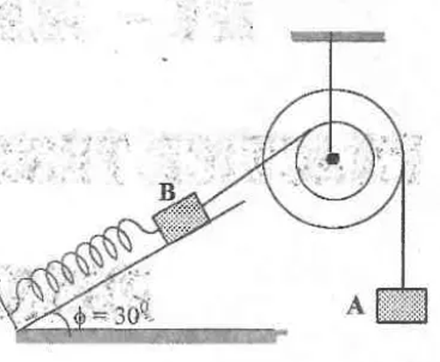
To determine the frequency of oscillation of block B in this system, we need to analyze the forces acting on both blocks and how they interact with the spring and the pulley. Let's break down the problem step by step.
Understanding the System
We have two blocks: block A with mass m and block B with mass 4m. Block B is resting on a smooth inclined plane at an angle of 30 degrees, and it is connected to a spring with stiffness k. The pulley has a mass m and a radius of 2R, while the spool attached to it has a radius of R. The system is set up such that when block A is pulled down and released, it will cause block B to oscillate due to the spring's restoring force.
Forces Acting on Block B
Block B experiences several forces:
- The gravitational force acting downwards, which can be calculated as \( F_g = 4m \cdot g \), where g is the acceleration due to gravity.
- The normal force from the inclined plane, which acts perpendicular to the surface.
- The spring force, which acts to restore the block to its equilibrium position when it is displaced.
Calculating the Effective Force
When block B is displaced by a small distance \( x \) along the incline, the spring force can be expressed as \( F_s = -kx \). The component of the gravitational force acting down the incline is given by \( F_{g,\text{incline}} = 4m \cdot g \cdot \sin(30^\circ) = 2mg \). Therefore, the net force acting on block B when it is displaced is:
Net Force (F_net) = F_s + F_{g,\text{incline}} = -kx + 2mg
Setting Up the Equation of Motion
According to Newton's second law, the net force is also equal to the mass times acceleration. For block B, we can write:
F_net = 4m \cdot a
Substituting the expression for net force gives us:
-kx + 2mg = 4m \cdot a
Since acceleration \( a \) can be expressed as the second derivative of displacement with respect to time, we can rewrite this as:
-kx + 2mg = 4m \cdot \frac{d^2x}{dt^2}
Finding the Frequency of Oscillation
This is a second-order linear differential equation that describes simple harmonic motion. Rearranging gives:
4m \cdot \frac{d^2x}{dt^2} + kx = 2mg
To find the frequency of oscillation, we can ignore the constant term (2mg) for small oscillations around the equilibrium position, leading to:
4m \cdot \frac{d^2x}{dt^2} + kx = 0
This can be compared to the standard form of simple harmonic motion:
\(\frac{d^2x}{dt^2} + \omega^2 x = 0\)
From this comparison, we can identify that:
\(\omega^2 = \frac{k}{4m}\)
Thus, the angular frequency \( \omega \) is:
\(\omega = \sqrt{\frac{k}{4m}}\)
Calculating the Frequency
The frequency \( f \) of oscillation is related to the angular frequency by the formula:
f = \frac{\omega}{2\pi}
Substituting for \( \omega \), we get:
f = \frac{1}{2\pi} \sqrt{\frac{k}{4m}} = \frac{1}{4\pi} \sqrt{\frac{k}{m}}
Final Result
In summary, the frequency of oscillation of block B, when block A is released, is given by:
f = \frac{1}{4\pi} \sqrt{\frac{k}{m}}
This result shows how the spring constant and the mass of block B influence the oscillation frequency, providing insight into the dynamics of the system.