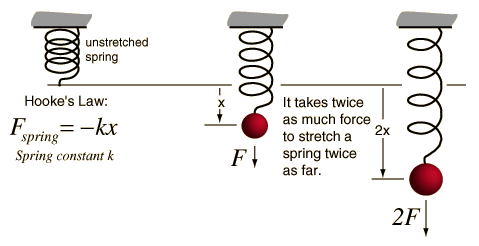
Elasticity is the property of an object or material which causes it to be restored to its original shape after distortion. It is said to be more elastic if it restores itself more precisely to its original configuration. A rubber band is easy to stretch, and snaps back to near its original length when released, but it is not as elastic as a piece of piano wire. The piano wire is harder to stretch, but would be said to be more elastic than the rubber band because of the precision of its return to its original length. A real piano string can be struck hundreds of times without stretching enough to go noticeably out of tune. A spring is an example of an elastic object - when stretched, it exerts a restoring force which tends to bring it back to its original length. This restoring force is generally proportional to the amount of stretch, as described by Hooke's Law. For wires or columns, the elasticity is generally described in terms of the amount of deformation (strain) resulting from a given stress (Young's modulus). Bulk elastic properties of materials describe the response of the materials to changes in pressure.
Hooke’s law,law of elasticity discovered by the English scientist Robert Hooke in 1660, which states that, for relatively small deformations of an object, the displacement or size of the deformation is directly proportional to the deforming force or load. Under these conditions the object returns to its original shape and size upon removal of the load. Elastic behaviour of solids according to Hooke’s law can be explained by the fact that small displacements of their constituent molecules, atoms, or ions from normal positions is also proportional to the force that causes the displacement.


 General Physics> How to contradict Hooke’s law of elastici...
 1 Answers
 Approved


