

Grade 10General Physics
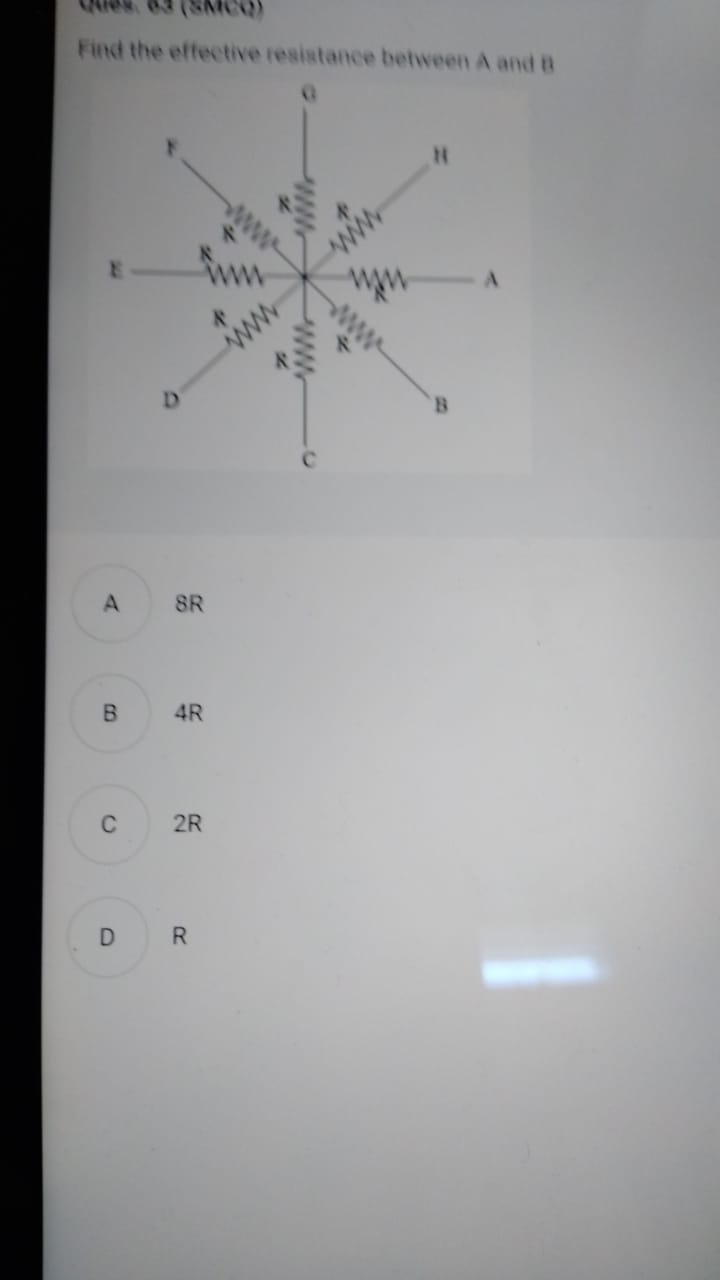
Find the effective resistance between A and B and please tell the process to solve
Find the effective resistance between A and B and please tell the process to solve


 Approved Tutor Answer1 Year ago
To find the effective resistance between two points A and B in a circuit, we need to analyze how the resistors are arranged—whether they are in series, parallel, or a combination of both. Let’s break down the process step by step.
Resistors can be connected in two primary ways:
Let’s go through the steps to find the effective resistance between points A and B:
First, look at the circuit diagram and identify how the resistors are connected. Are they in series, parallel, or a combination? This will dictate how you calculate the total resistance.
If the resistors are in series, use the formula:
R_total = R1 + R2 + R3 + ...
For example, if you have three resistors of 2Ω, 3Ω, and 5Ω in series, the total resistance would be:
R_total = 2 + 3 + 5 = 10Ω
If the resistors are in parallel, apply the parallel resistance formula:
1/R_total = 1/R1 + 1/R2 + 1/R3 + ...
For instance, if you have two resistors of 4Ω and 6Ω in parallel, the calculation would be:
1/R_total = 1/4 + 1/6
Finding a common denominator (12), we get:
1/R_total = 3/12 + 2/12 = 5/12
Thus, R_total = 12/5 = 2.4Ω
In many circuits, you will encounter a combination of series and parallel resistors. In such cases, simplify the circuit step by step:
Imagine a circuit where you have two resistors, 4Ω and 6Ω, in parallel, and this combination is in series with a 5Ω resistor. Here’s how you would solve it:
Thus, the effective resistance between points A and B is 7.4Ω.
By following these steps and understanding the configurations, you can effectively determine the resistance in various circuit setups. Practice with different combinations to strengthen your grasp on the topic!

In viewing through a magnifying glass, one usually positions one's eyes very close to the lens. Does angular magnification change if the eye is moved back?
Last Activity: 9 Months ago
Last Activity: 3 Years ago
Last Activity: 3 Years ago
Last Activity: 3 Years ago
Last Activity: 3 Years ago