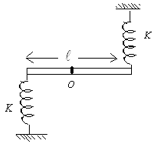
To determine the angular frequency of oscillation for the uniform rod when it is slightly turned and released, we can analyze the system using principles from physics involving rotational motion and harmonic oscillators. Here’s how we can approach this problem step by step.
Understanding the System
In this scenario, we have a uniform rod of length 40 cm (0.4 m) and mass 1.2 kg, pivoted at its center. The two springs are attached at each end, and they provide a restoring force when the rod is displaced from its equilibrium position. The force constant of each spring is given as K = 320 N/m.
Calculating the Moment of Inertia
The moment of inertia (I) of a uniform rod about its center is given by the formula:
I = (1/12) * m * L²
Where:
- m is the mass of the rod (1.2 kg)
- L is the length of the rod (0.4 m)
Plugging in the values:
I = (1/12) * 1.2 kg * (0.4 m)² = 0.016 kg·m²
Finding the Effective Torque
When the rod is displaced by a small angle θ, the springs exert a restoring torque. The torque (τ) due to the springs can be calculated as:
τ = -2K * x
Here, x is the displacement from the equilibrium position. For small angles, we can relate the displacement to the angle θ using the formula:
x = (L/2) * θ
Thus, the torque becomes:
τ = -2K * (L/2) * θ = -K * L * θ
Substituting L = 0.4 m and K = 320 N/m:
τ = -320 N/m * 0.4 m * θ = -128 θ
Setting Up the Equation of Motion
The angular motion can be described by Newton’s second law for rotation:
τ = I * α
Where α is the angular acceleration. Substituting the expressions for torque and moment of inertia:
-128 θ = 0.016 α
Since α can be expressed as:
α = (d²θ/dt²)
We can rewrite the equation as:
0.016 (d²θ/dt²) + 128 θ = 0
Angular Frequency Calculation
This is a standard form of a simple harmonic motion equation:
(d²θ/dt²) + (ω²)θ = 0
Where the angular frequency ω is given by:
ω² = 128 / 0.016
Calculating ω:
ω² = 8000
Therefore:
ω = √8000 ≈ 89.44 rad/s
Final Result
Thus, the angular frequency of oscillation of the rod when it is slightly turned and released is approximately 89.44 radians per second. This result showcases how the interplay between the springs and the moment of inertia of the rod dictates the oscillation characteristics of the system.