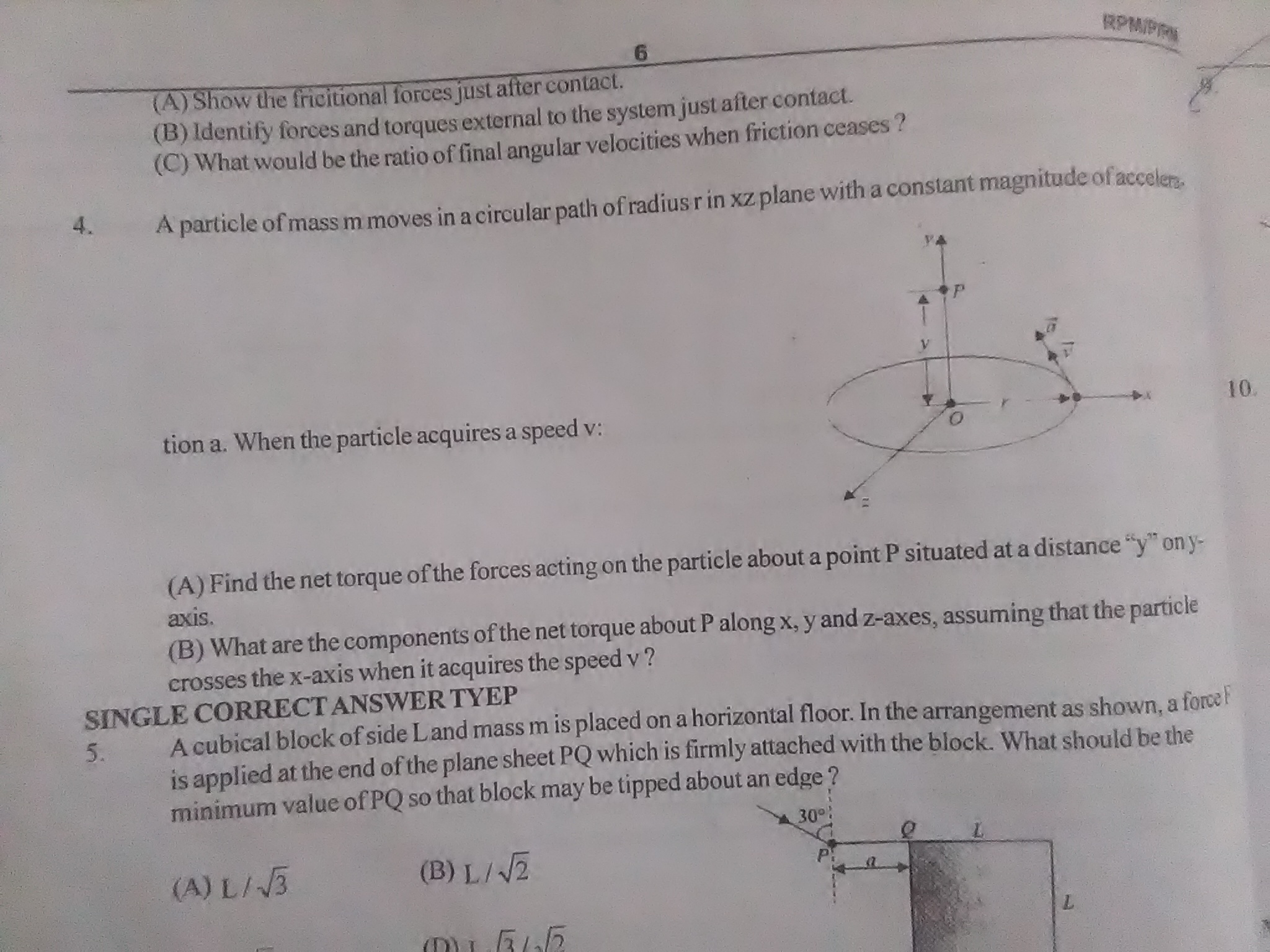
When a particle of mass m moves in a circular path of radius r in the xz plane with a constant magnitude of acceleration a, we can analyze its motion using concepts from physics, particularly circular motion and acceleration. Let's break this down step by step to understand the dynamics involved.
Understanding Circular Motion
Circular motion occurs when an object travels along a circular path. In this case, the particle is constrained to move in a circle of radius r. The key aspect of circular motion is that even if the speed of the particle remains constant, its direction changes continuously, which means it is always accelerating towards the center of the circle. This is known as centripetal acceleration.
Types of Acceleration
In this scenario, we have two types of acceleration to consider:
- Centripetal Acceleration: This is the acceleration directed towards the center of the circular path, necessary for maintaining circular motion. It can be calculated using the formula:
- Linear Acceleration: This is the constant acceleration a mentioned in the question. It can be tangential to the circular path, affecting the speed of the particle.
Calculating Centripetal Acceleration
The centripetal acceleration (a_c) required to keep the particle moving in a circle is given by the formula:
a_c = v² / r
where v is the tangential speed of the particle. If the particle is also experiencing a constant linear acceleration a, we need to consider how this affects the speed over time.
Combining Accelerations
If the particle starts from rest and accelerates tangentially with a constant acceleration a, its speed at any time t can be expressed as:
v = a * t
Substituting this expression for v into the centripetal acceleration formula gives:
a_c = (a * t)² / r
This means that as time progresses, the centripetal acceleration increases due to the increasing speed of the particle as it accelerates tangentially.
Net Acceleration of the Particle
The total acceleration of the particle is a combination of the centripetal acceleration and the tangential acceleration. The net acceleration can be found using vector addition, as these two components are perpendicular to each other:
a_net = √(a_c² + a²)
Substituting the expression for centripetal acceleration gives:
a_net = √(((a * t)² / r)² + a²)
Example Calculation
Let’s say we have a particle of mass m = 2 kg moving in a circular path of radius r = 5 m, with a constant tangential acceleration a = 3 m/s². After 2 seconds, we can calculate the speed:
v = a * t = 3 m/s² * 2 s = 6 m/s
Now, we can find the centripetal acceleration:
a_c = v² / r = (6 m/s)² / 5 m = 36 / 5 = 7.2 m/s²
Finally, the net acceleration at this point would be:
a_net = √(7.2² + 3²) = √(51.84 + 9) = √60.84 ≈ 7.8 m/s²
Visualizing the Motion
To visualize this, imagine the particle moving in a circular path while simultaneously speeding up. The direction of the net acceleration will always point towards the center of the circle, while the tangential acceleration will point along the direction of motion. This combination creates a spiraling effect as the particle moves faster along its circular path.
In summary, analyzing a particle moving in a circular path with constant acceleration involves understanding both centripetal and tangential components of acceleration. By applying the relevant formulas, we can derive the net acceleration and gain insights into the particle's motion over time.