

Grade 12General Physics
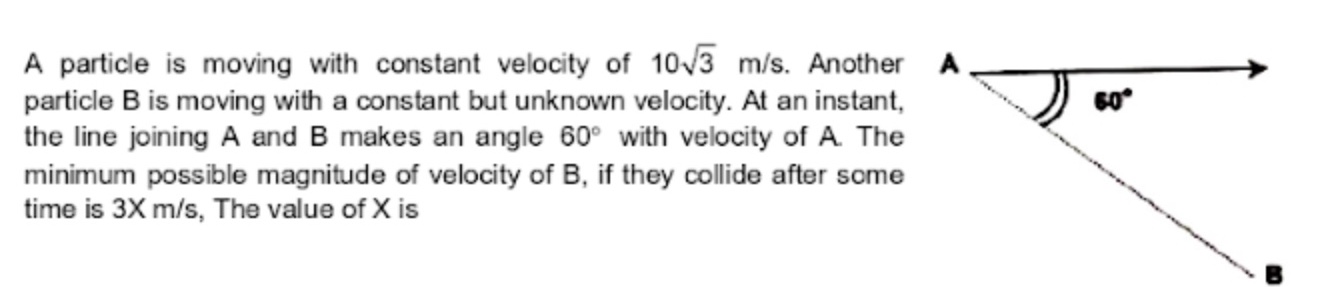
a particle is moving with a constant velocity of 10 root 3....rest of the question i s continued in image
a particle is moving with a constant velocity of 10 root 3....rest of the question i s continued in image


 Approved Tutor Answer1 Year ago
To address your question about a particle moving with a constant velocity of \(10\sqrt{3}\), let's break down the concepts involved and analyze the situation step by step. Since I can't see the image you mentioned, I will provide a general explanation based on typical scenarios involving constant velocity and motion.
When we say a particle is moving with a constant velocity, it means that both the speed and direction of the particle remain unchanged over time. In this case, the speed is given as \(10\sqrt{3}\) units per second. This is a crucial point because it implies that the particle is not accelerating or decelerating.
To find out how far the particle travels over a certain period, we can use the formula:
Distance = Speed × Time
For example, if you want to know how far the particle travels in 5 seconds, you would calculate:
Distance = \(10\sqrt{3} \times 5\)
This results in:
Distance = \(50\sqrt{3}\) units
Let’s say you want to determine how far the particle travels in 10 seconds. Using the same formula:
Distance = \(10\sqrt{3} \times 10 = 100\sqrt{3}\) units
In this case, the particle would cover \(100\sqrt{3}\) units in 10 seconds.
If you were to graph the motion of this particle, you would see a straight line on a position-time graph, indicating that the position changes linearly with time. The slope of this line would represent the constant velocity of \(10\sqrt{3}\).
Understanding constant velocity is essential in various fields, including physics, engineering, and even everyday life. For instance, when a car travels at a steady speed on a highway, it exemplifies constant velocity, assuming there are no changes in direction or speed.
In summary, a particle moving with a constant velocity of \(10\sqrt{3}\) means it travels at that speed indefinitely in a straight line unless acted upon by an external force. This concept is foundational in kinematics and helps us analyze motion in a straightforward manner. If you have specific details from the image or further questions, feel free to share, and we can delve deeper into those aspects!

In viewing through a magnifying glass, one usually positions one's eyes very close to the lens. Does angular magnification change if the eye is moved back?
Last Activity: 9 Months ago
Last Activity: 3 Years ago
Last Activity: 3 Years ago
Last Activity: 3 Years ago
Last Activity: 3 Years ago