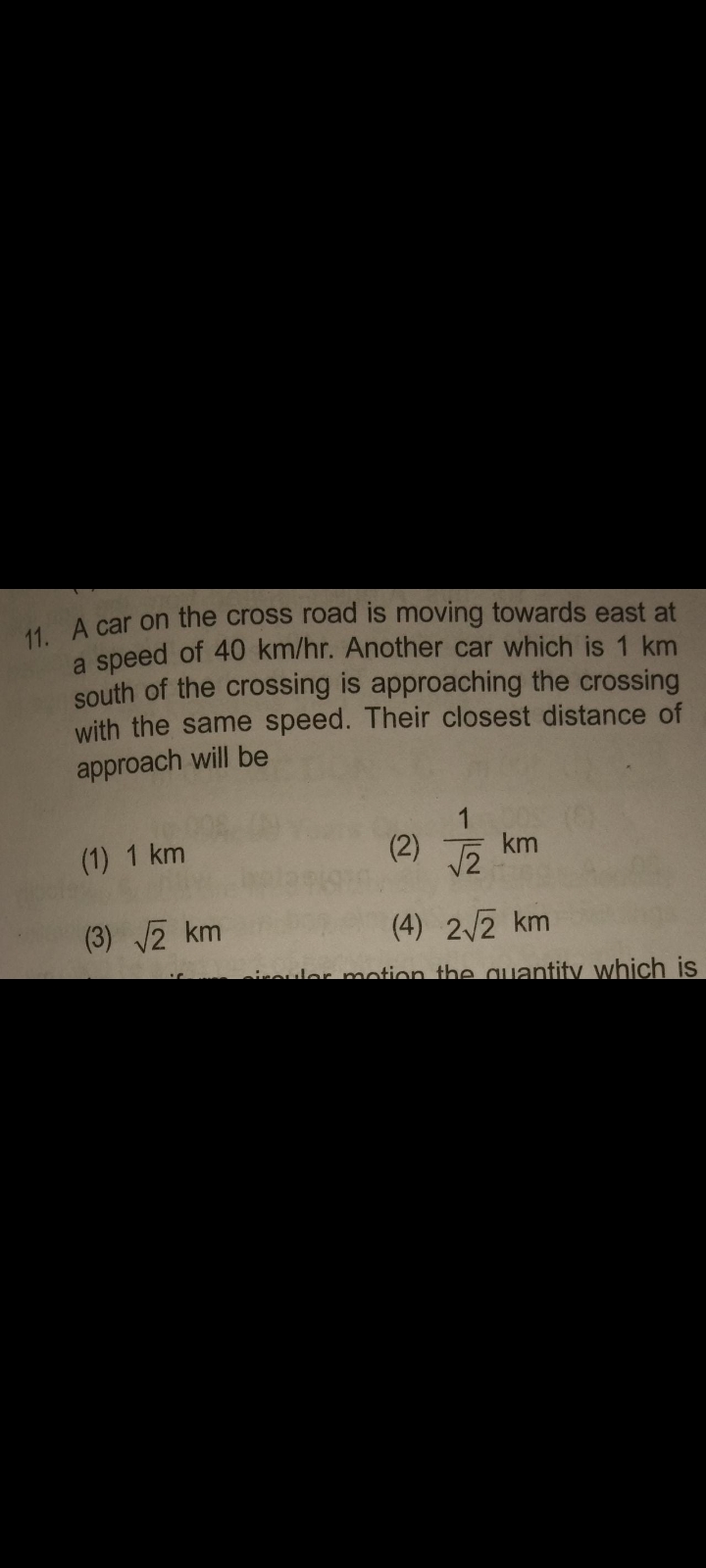
To analyze the situation involving the two cars, we need to break down their positions and movements. We have one car moving east at a speed of 40 km/h, and another car located 11 km directly south of the first car. Let's delve into the details to understand their relative positions and how we can calculate various aspects of their movement.
Understanding the Positions
Imagine a coordinate system where the first car, moving east, is at the origin point (0, 0). The second car, which is 11 km south, would be positioned at (0, -11). This setup allows us to visualize their movements more clearly.
Movement of the First Car
The first car is traveling east at a speed of 40 km/h. If we want to determine its position after a certain amount of time, we can use the formula:
For example, after 1 hour, the first car would have traveled:
- Distance = 40 km/h × 1 h = 40 km
So, after 1 hour, the first car would be at (40, 0).
Position of the Second Car
The second car remains stationary at (0, -11) unless stated otherwise. If we want to find the distance between the two cars at any given time, we can use the distance formula:
- Distance = √[(x2 - x1)² + (y2 - y1)²]
Here, (x1, y1) is the position of the first car, and (x2, y2) is the position of the second car. For instance, after 1 hour, the first car is at (40, 0) and the second car is at (0, -11). Plugging in these values:
- Distance = √[(40 - 0)² + (0 - (-11))²]
- Distance = √[1600 + 121] = √1721 ≈ 41.5 km
Further Analysis
If you want to know how far apart the two cars will be after a specific time, you can repeat this process for any time interval. Just remember to adjust the position of the first car based on its speed and the time elapsed.
Real-World Application
This type of problem is common in physics and navigation, where understanding relative motion and distance is crucial. For example, if both cars were to continue moving, you could calculate when they might intersect or how far apart they would be at any given moment.
In summary, by using basic principles of geometry and motion, we can effectively analyze the positions and movements of the two cars. This approach not only helps in solving the problem at hand but also enhances our understanding of relative motion in real-world scenarios.