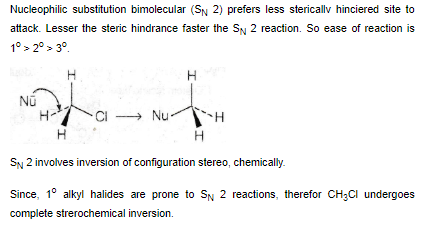
To determine which of the given organic chloro compounds undergoes complete stereochemical inversion during an SN2 reaction, we need to consider the structure of each compound and how they interact with the nucleophile in an SN2 mechanism. The key characteristic of an SN2 reaction is that it involves a backside attack by the nucleophile, which results in the inversion of configuration at the carbon atom that is bonded to the leaving group (in this case, the chlorine atom).
Analyzing Each Compound
Let’s break down the options you provided:
- (CH3)2CHCl: This is isopropyl chloride, where the carbon attached to Cl is secondary. Due to steric hindrance from the two methyl groups, this compound does not undergo a typical SN2 reaction efficiently.
- CH3Cl: Methyl chloride is a primary alkyl halide and is highly reactive in SN2 reactions. The nucleophile can easily attack the carbon, leading to stereochemical inversion. However, it does not have a chiral center, so the concept of stereochemical inversion is not applicable.
- (C2H5)2CHCl: This is a secondary alkyl halide as well, with two ethyl groups. Similar to isopropyl chloride, it experiences significant steric hindrance, making SN2 reactions less favorable and leading to incomplete inversion or even elimination reactions.
- (CH3)3CCl: This is tert-butyl chloride, which is a tertiary alkyl halide. Tertiary carbons are too hindered for SN2 reactions to occur; instead, they typically undergo SN1 reactions, which do not involve stereochemical inversion.
Identifying the Correct Compound
Given the nature of these compounds, the only one that is a primary alkyl halide and undergoes complete stereochemical inversion during an SN2 reaction is CH3Cl. However, since it lacks a chiral center, it cannot truly exhibit stereochemical inversion. Therefore, the question might be misleading as none of the options provided truly exhibit complete stereochemical inversion in the context of having a chiral center.
Conclusion
To recap, if we are strictly looking for a compound that would show stereochemical inversion during an SN2 reaction, we would ideally want a primary alkyl halide with a chiral center. Among the options provided, while CH3Cl is the only one that fits the SN2 profile, it does not have chirality. The other compounds either do not undergo SN2 due to steric hindrance or are tertiary and favor different reaction pathways.