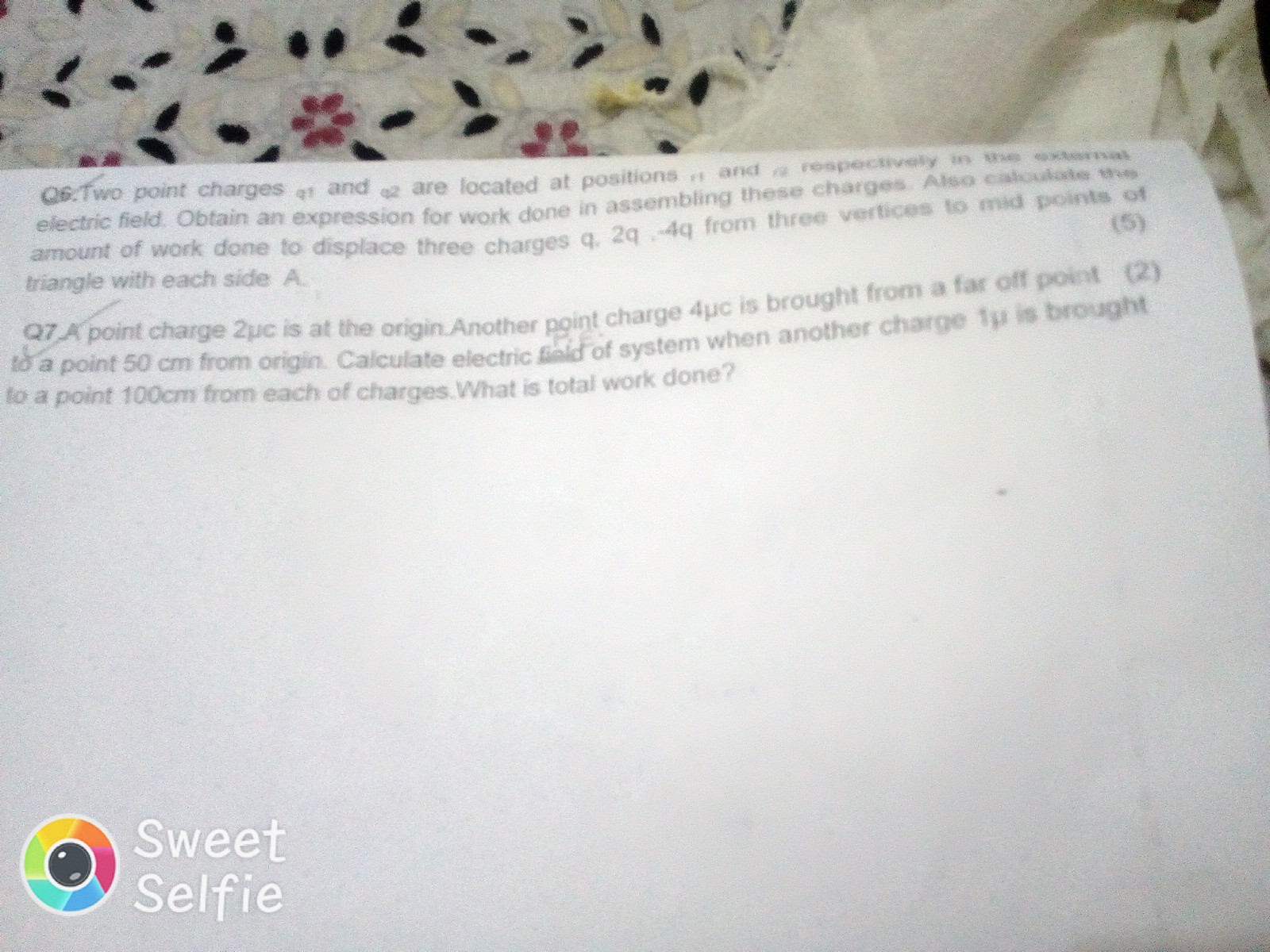
To calculate the work done in displacing the charges from the vertices of a triangle to the midpoints of the sides, we first need to understand the concept of electric potential energy and the work done against electric forces. The work done in moving a charge in an electric field is equal to the change in electric potential energy of the system.
Understanding the Setup
Consider a triangle with vertices A, B, and C, where we have three charges: q at vertex A, 2q at vertex B, and -4q at vertex C. The side length of the triangle is A. We want to move these charges to the midpoints of the sides of the triangle.
Identifying the Midpoints
The midpoints of the sides of the triangle are as follows:
- Midpoint M1 between A and B
- Midpoint M2 between B and C
- Midpoint M3 between C and A
Calculating the Distances
The distance from each vertex to its corresponding midpoint can be calculated. For a triangle with side length A, the distance from a vertex to the midpoint of the opposite side is given by:
Distance = A/2
Work Done on Each Charge
The work done to move a charge in an electric field is given by the formula:
W = qΔV
Where W is the work done, q is the charge being moved, and ΔV is the change in electric potential. To find ΔV, we need to calculate the potential at the midpoints due to the other charges.
Calculating Electric Potential at Midpoints
Let's calculate the electric potential at each midpoint due to the other two charges:
Electric Potential at M1
At midpoint M1, the potential due to charges at A and C is:
V(M1) = k(q/r1) + k(−4q/r2)
Where:
- r1 = A/2 (distance from A to M1)
- r2 = √(A² + (A/2)²) = A√(5)/2 (distance from C to M1)
Thus, substituting the values:
V(M1) = k(q/(A/2)) + k(−4q/(A√5/2))
Electric Potential at M2 and M3
Similarly, we can calculate the potentials at M2 and M3 using the same approach, considering the distances from the respective charges.
Calculating Total Work Done
Once we have the potentials at M1, M2, and M3, we can find the work done for each charge:
- For charge q moving to M1: W1 = q(V(M1) - V(A))
- For charge 2q moving to M2: W2 = 2q(V(M2) - V(B))
- For charge -4q moving to M3: W3 = -4q(V(M3) - V(C))
Finally, the total work done is the sum of the work done on each charge:
Total Work = W1 + W2 + W3
Final Thoughts
This approach gives you a systematic way to calculate the work done in moving charges within an electric field. Each step involves understanding the contributions of electric potentials and how they change as charges are moved. By carefully calculating the potentials and applying the work formula, you can find the total work done in this scenario.