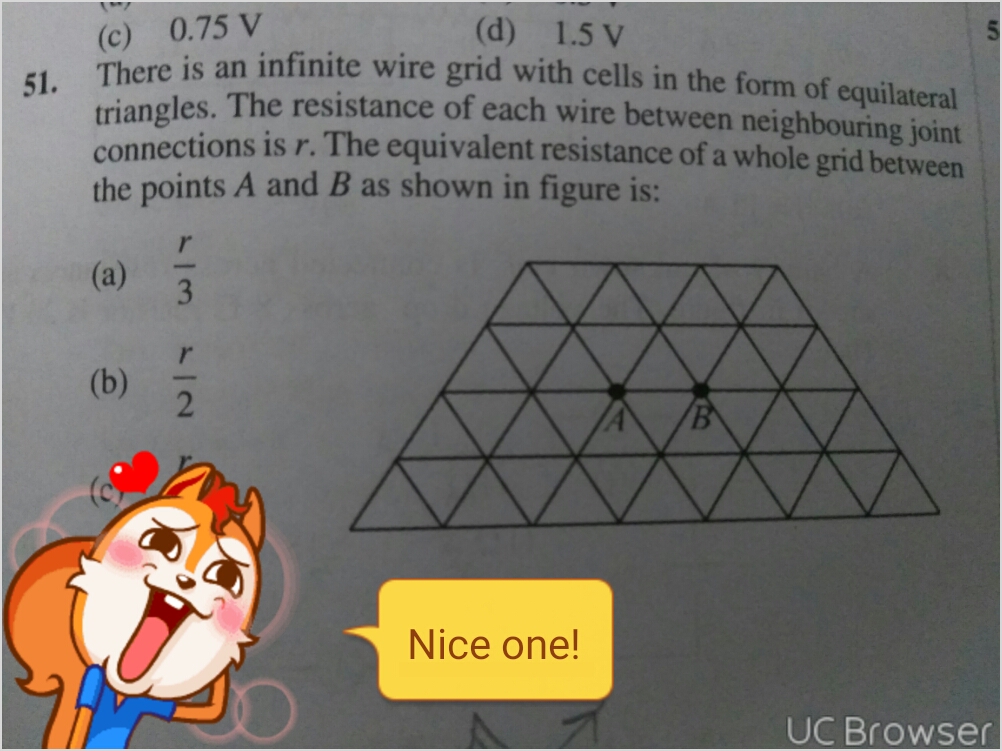
To determine the equivalent resistance between two conjugated points in an infinite triangular grid, we need to delve into some concepts of electrical circuits and symmetry. This problem is quite fascinating because it combines geometry with electrical properties, and it can be approached using both theoretical analysis and symmetry arguments.
Understanding the Infinite Triangular Grid
Imagine an infinite grid made up of equilateral triangles. Each vertex of the triangles represents a junction where resistors are connected. For simplicity, let's assume that each resistor has the same resistance value, denoted as R. The grid extends infinitely in all directions, which means that the behavior of the circuit at any point is influenced by the resistors around it.
Setting Up the Problem
To find the equivalent resistance between two points, let's label two adjacent vertices in the grid as A and B. The goal is to calculate the resistance between these two points. Due to the symmetry of the grid, we can use some clever reasoning to simplify our calculations.
Using Symmetry
In an infinite grid, the resistance seen from any point is the same in all directions. This symmetry allows us to analyze the circuit without having to consider the entire infinite structure. We can focus on the local connections around points A and B.
Calculating the Equivalent Resistance
To find the equivalent resistance, we can employ the method of superposition or use the concept of infinite series. Here’s a step-by-step approach:
- Identify the connections: Each point in the grid connects to three other points. For points A and B, there are direct connections to their neighboring points.
- Use symmetry: The resistances from A to its neighbors are the same, and the same applies to B. This means we can treat the resistances in a uniform manner.
- Set up equations: By applying Kirchhoff's laws, we can set up equations based on the current flowing through the resistors. The symmetry allows us to simplify these equations significantly.
- Calculate the total resistance: The equivalent resistance can be derived from the relationships established in the previous steps. For an infinite triangular grid, the equivalent resistance between two adjacent points A and B is given by:
R_eq = R / (2√3)
Visual Representation
While I can't provide a diagram directly, you can visualize the grid as follows:
- Draw a series of equilateral triangles, ensuring that they connect at their vertices.
- Label two adjacent vertices as A and B.
- From each vertex, draw lines to the three neighboring vertices, representing the resistors.
This visual representation will help you see how the resistors are interconnected and how the symmetry plays a crucial role in simplifying the problem.
Conclusion
Finding the equivalent resistance in an infinite triangular grid is a beautiful example of how geometry and electrical principles intertwine. By leveraging symmetry and understanding the connections between points, we can derive meaningful results without needing to analyze the entire grid. This approach not only simplifies calculations but also deepens our understanding of electrical networks.