
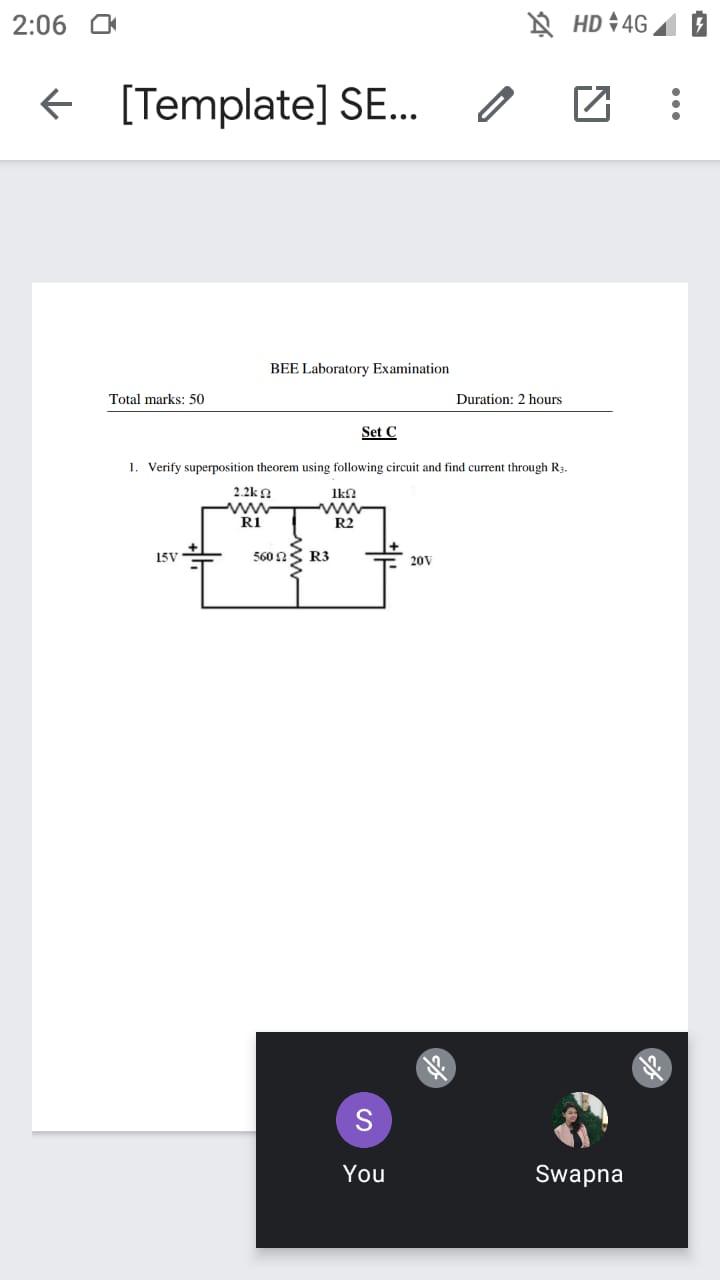
Verify maximum power transfer theorem using following circuit where load resistance is 330ohm
Verify maximum power transfer theorem using following circuit where load resistance is 330ohm

SUVHAM VERMA , 4 Years ago
Grade 12th pass
 Electric Current> Verify maximum power transfer theorem usi...
 1 Answers
The maximum power transfer theorem is a fundamental principle in electrical engineering that states that to obtain maximum power from a source to a load, the load resistance must equal the Thevenin resistance of the source network when viewed from the load's perspective. Let's verify this theorem using a circuit with a load resistance of 330 ohms.
To verify the maximum power transfer theorem, we need to consider a simple circuit that includes a voltage source (V) and a series resistance (R_s), which represents the internal resistance of the source. The load resistance (R_L) is given as 330 ohms.
P = (V_th^2 * R_L) / (R_th + R_L)^2
Let’s assume we have a voltage source of 12V and a series resistance of 120 ohms. In this case:
Now, we will calculate the power delivered to the load when R_L is 330 ohms:
Using the power formula:
P = (12^2 * 330) / (120 + 330)^2
P = (144 * 330) / (450)^2
P = 47520 / 202500
P ≈ 0.234 W or 234 mW
Next, we will find the maximum power when R_L equals R_th (120 ohms):
P_max = (12^2 * 120) / (120 + 120)^2
P_max = (144 * 120) / (240)^2
P_max = 17280 / 57600
P_max = 0.3 W or 300 mW
From our calculations, we observe that the power delivered to the load when R_L is 330 ohms is less than the maximum power delivered when R_L equals R_th (120 ohms). This confirms the maximum power transfer theorem: for maximum power transfer, the load resistance must match the Thevenin resistance of the circuit. In practical applications, this principle is crucial for optimizing the performance of electrical systems, ensuring that devices receive adequate power for efficient operation.
 Approved
Prepraring for the competition made easy just by live online class.

Full Live Access

Study Material

Live Doubts Solving

Daily Class Assignments

Last Activity: 3 Years ago
Last Activity: 4 Years ago
Last Activity: 4 Years ago