

Grade 12Electric Current
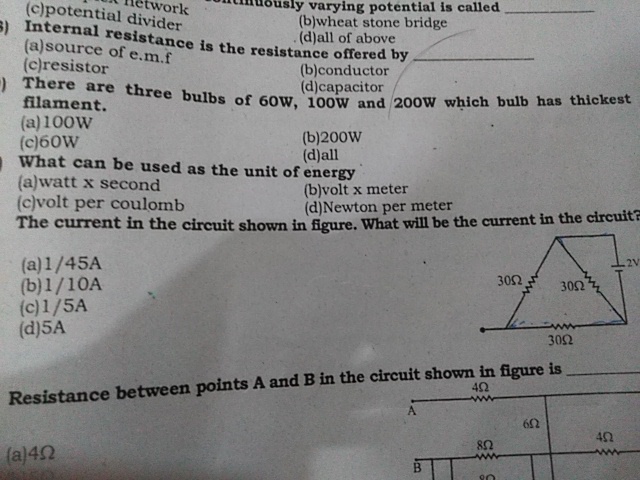
Trick to solve problems relating finding cuurent in the circuit like in the figure shown
Trick to solve problems relating finding cuurent in the circuit like in the figure shown


 Approved Tutor Answer11 Months ago
When it comes to finding the current in a circuit, there are several strategies and principles that can help simplify the process. Whether you're dealing with series circuits, parallel circuits, or a combination of both, understanding the underlying concepts will make problem-solving much easier. Let’s break it down step by step.
Before diving into problem-solving, it’s essential to grasp some fundamental concepts:
Here’s a methodical approach to tackle current-related problems:
Start by carefully examining the circuit diagram. Identify all components, including resistors, batteries, and any other elements. Label the known values, such as voltages and resistances.
If the circuit is complex, try to simplify it. For series components, add their resistances together. For parallel components, use the formula:
1/R_total = 1/R1 + 1/R2 + ... + 1/Rn
Once you have the total resistance, you can find the current using Ohm's Law. If you know the total voltage supplied by the battery, rearrange the formula to find the current:
I = V/R_total
If the circuit has multiple loops or branches, Kirchhoff's Voltage Law (KVL) and Kirchhoff's Current Law (KCL) can be invaluable. KVL states that the sum of the electrical potential differences (voltage) around any closed network is zero. KCL states that the total current entering a junction must equal the total current leaving the junction.
With the equations set up from KVL and KCL, you can solve for unknown currents. This often involves setting up a system of equations that can be solved using substitution or elimination methods.
Let’s say you have a simple circuit with a 12V battery and two resistors in series: R1 = 4Ω and R2 = 2Ω. To find the current:
Thus, the current flowing through the circuit is 2A.
By following these steps and principles, you’ll find that solving for current in circuits becomes a more manageable and systematic task. Keep practicing, and soon it will feel second nature!

Last Activity: 4 Years ago
Last Activity: 4 Years ago
Last Activity: 4 Years ago
Last Activity: 4 Years ago
Last Activity: 4 Years ago