
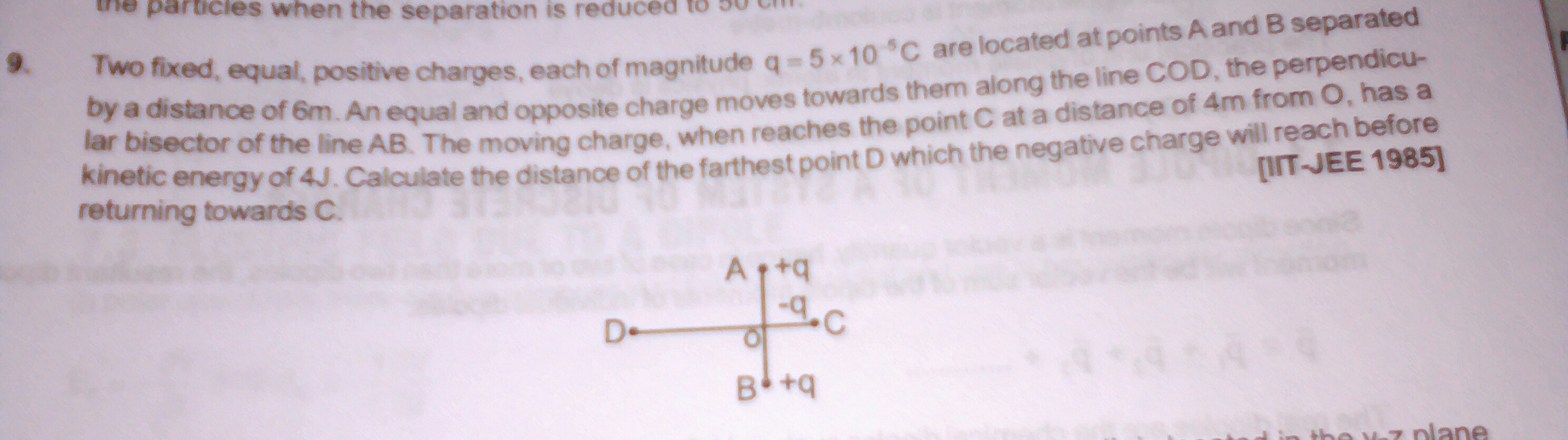
This question has been asked in IIT JEE 1985. sir please give the answer.

Mayank , 8 Years ago
Grade 12th pass
 Electric Current> This question has been asked in IIT JEE 1...
 1 Answers
It seems you're referring to a specific question from the IIT JEE exam in 1985. While I don't have access to the exact question, I can certainly help you understand common topics and concepts that are often tested in IIT JEE, especially in subjects like Physics, Chemistry, or Mathematics. If you can provide me with the details of the question, I can give you a more tailored explanation and solution.
The IIT JEE exam covers a wide range of topics across three main subjects. Here’s a brief overview of some key areas:
When tackling questions from IIT JEE, it’s important to follow a systematic approach:
Understanding what is being asked is crucial. Look for keywords that indicate the type of problem, such as "calculate," "prove," or "derive."
Link the question to the concepts you’ve learned. For example, if it’s a mechanics problem, recall the laws of motion or energy conservation principles.
Divide the problem into manageable parts. If it involves multiple steps, tackle each step one at a time.
After arriving at a solution, double-check your calculations and reasoning. Ensure that your answer makes sense in the context of the question.
Let’s consider a hypothetical physics problem: "A ball is thrown vertically upwards with an initial velocity of 20 m/s. Calculate the maximum height it reaches." Here’s how you would approach it:
The formula for maximum height (h) when an object is thrown upwards is given by:
h = (u²) / (2g)
where u is the initial velocity and g is the acceleration due to gravity (approximately 9.81 m/s²).
Using u = 20 m/s and g = 9.81 m/s²:
h = (20²) / (2 * 9.81) = 400 / 19.62 ≈ 20.39 m
The maximum height reached by the ball is approximately 20.39 meters.
If you have a specific question from the IIT JEE 1985 exam, please share it, and I’ll be glad to help you work through it step by step!
 Approved
Prepraring for the competition made easy just by live online class.

Full Live Access

Study Material

Live Doubts Solving

Daily Class Assignments

Last Activity: 3 Years ago
Last Activity: 3 Years ago
Last Activity: 4 Years ago