

Grade 11Electric Current
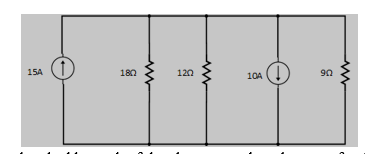
Obtain the current through the 12 Ohm resistor with the help of Kirchhoff’s laws
Obtain the current through the 12 Ohm resistor with the help of Kirchhoff’s laws


 Approved Tutor Answer1 Year ago
To find the current through a 12 Ohm resistor using Kirchhoff's laws, we first need to understand the basic principles behind these laws. Kirchhoff's laws consist of two main rules: Kirchhoff's Current Law (KCL) and Kirchhoff's Voltage Law (KVL). KCL states that the total current entering a junction must equal the total current leaving that junction, while KVL states that the sum of the electrical potential differences (voltage) around any closed circuit must equal zero. Let’s apply these concepts step by step.
Imagine a simple circuit that includes a voltage source and a 12 Ohm resistor. For this example, let’s say we have a 24V battery connected in series with the 12 Ohm resistor. We will analyze the circuit to find the current flowing through the resistor.
According to KVL, we can write the equation for the loop in our circuit. The voltage provided by the battery must equal the voltage drop across the resistor. The formula for the voltage drop across a resistor is given by Ohm's Law, which states:
Where:
Now, applying KVL, we can set up the equation:
Rearranging the equation gives us:
Now, divide both sides by 12 Ohms to isolate the current (I):
Calculating this gives:
The current flowing through the 12 Ohm resistor is 2 Amperes. This example illustrates how Kirchhoff’s laws can be effectively used to analyze simple electrical circuits. By applying KVL, we can relate the voltage supplied by the source to the voltage drop across the resistor, allowing us to calculate the current with ease. If you have any more questions about circuit analysis or related topics, feel free to ask!

Last Activity: 4 Years ago
Last Activity: 4 Years ago
Last Activity: 4 Years ago
Last Activity: 4 Years ago
Last Activity: 4 Years ago