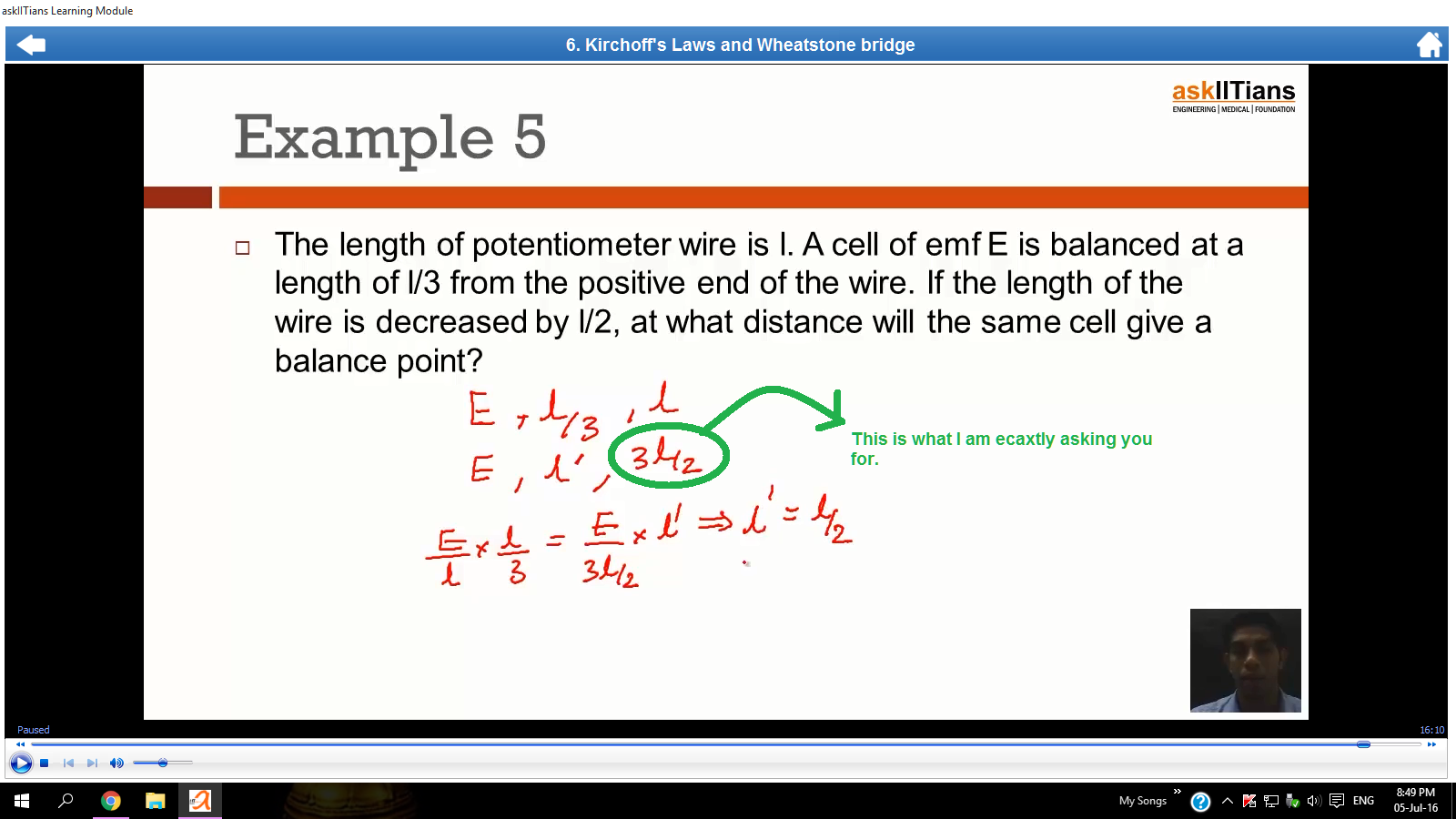
To address your question about Example 5 in the current electricity chapter, let’s break down the concept of how the new length becomes 3l/2. This typically involves understanding the relationship between resistance, length, and cross-sectional area in a conductor. Let’s dive into the details.
Understanding Resistance in Conductors
Resistance (R) in a conductor is influenced by three main factors: the material's resistivity (ρ), the length of the conductor (l), and its cross-sectional area (A). The formula for resistance is given by:
R = ρ(l/A)
From this equation, we can see that if we change the length or the area of the conductor, the resistance will change accordingly. Now, let’s consider how this applies to your example.
Scenario Breakdown
Imagine you have a conductor of length l and you are altering its dimensions. The problem likely involves either stretching the conductor or changing its shape, which affects its length and area. Here’s a common scenario:
- If you stretch a wire, its length increases while its cross-sectional area decreases.
- For instance, if the original length is l and you stretch it to a new length, say 3l/2, the area will change as well.
Calculating the New Length
Let’s say you are given a specific condition that the volume of the conductor remains constant during this process. The volume (V) of a cylinder, which is a common shape for wires, is calculated as:
V = A × l
When you stretch the wire to a new length (3l/2), you can express the new area (A') in terms of the original area (A) and the original length (l):
V = A × l = A' × (3l/2)
From this, you can derive:
A' = (2A)/3
This means that as the length increases to 3l/2, the cross-sectional area must decrease to maintain the same volume. This relationship is crucial in understanding how the dimensions of the conductor affect its electrical properties.
Example Application
Let’s say you started with a copper wire of length 1 meter and a cross-sectional area of 1 mm². If you stretch this wire to a length of 1.5 meters (which is 3/2 of the original length), the new area would be:
A' = (2 × 1 mm²) / 3 = 0.67 mm²
This example illustrates how the dimensions of the wire change while keeping the volume constant, leading to the new length of 3l/2. It’s a practical application of the principles of current electricity and resistance.
Final Thoughts
In summary, the transformation of the length to 3l/2 in your example is a result of maintaining constant volume while altering the dimensions of the conductor. This relationship between length, area, and resistance is fundamental in understanding how electrical properties change in conductive materials. If you have any further questions or need clarification on any specific part, feel free to ask!