

Grade 12th passElectric Current
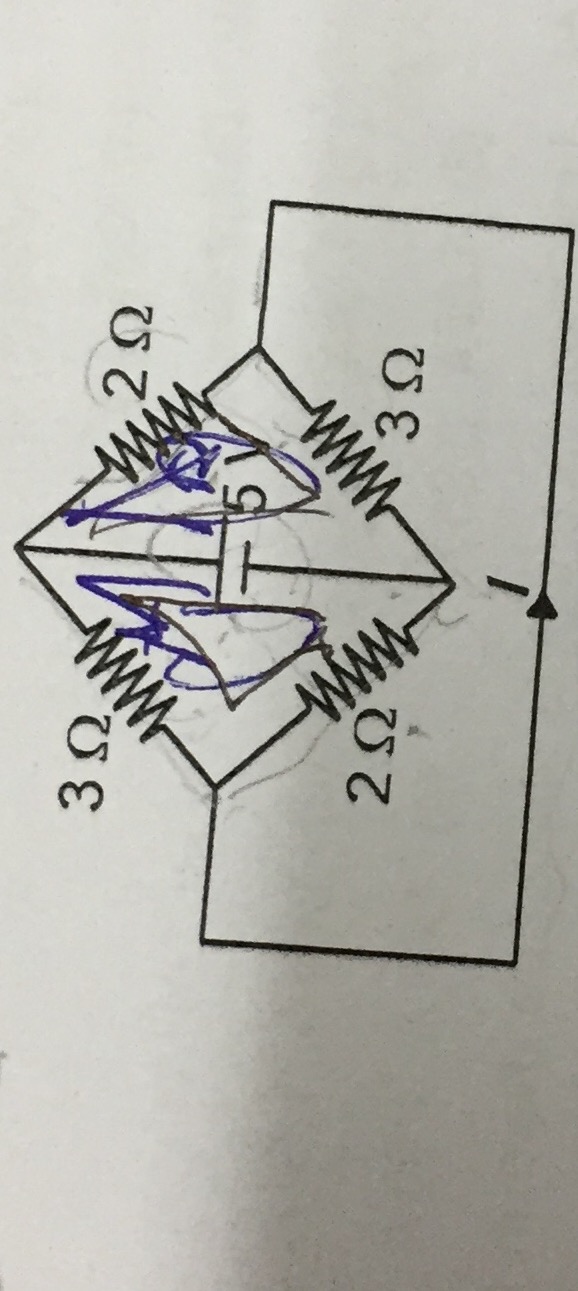
In the given circuit, calculate the value of ‘I’ using Kirchoff’s Voltge law.
In the given circuit, calculate the value of ‘I’ using Kirchoff’s Voltge law.


 Approved Tutor Answer1 Year ago
To calculate the current 'I' in a circuit using Kirchhoff's Voltage Law (KVL), we first need to understand the principles behind KVL. This law states that the sum of the electrical potential differences (voltage) around any closed network is zero. In simpler terms, the total voltage supplied in a loop must equal the total voltage dropped across the components in that loop.
Let’s assume we have a simple circuit consisting of a voltage source (V) and resistors (R1, R2, etc.). To apply KVL, we need to identify a loop in the circuit. For our example, let’s say we have a voltage source of 10V and two resistors, R1 = 2Ω and R2 = 3Ω, connected in series.
In a series circuit, the current (I) is the same through all components. According to KVL, we can write the equation for the loop as follows:
Mathematically, this can be expressed as:
V - I * R1 - I * R2 = 0
Substituting the known values into the equation:
10V - I * 2Ω - I * 3Ω = 0
Now, we can simplify the equation:
10V = I * (2Ω + 3Ω)
10V = I * 5Ω
To find 'I', we divide both sides by 5Ω:
I = 10V / 5Ω
I = 2A
The calculated current 'I' is 2 amperes. This means that in our circuit, a current of 2A flows through both resistors. This example illustrates how KVL helps us analyze circuits by providing a systematic way to account for voltages in a loop.
Using Kirchhoff's Voltage Law is essential in circuit analysis, especially when dealing with more complex circuits involving multiple loops and components. It allows engineers and technicians to ensure that their designs are efficient and that all components are functioning as intended.
In summary, by applying KVL, we can effectively determine the current flowing in a circuit, which is crucial for both theoretical understanding and practical applications in electrical engineering.

Last Activity: 4 Years ago
Last Activity: 4 Years ago
Last Activity: 4 Years ago
Last Activity: 4 Years ago
Last Activity: 4 Years ago