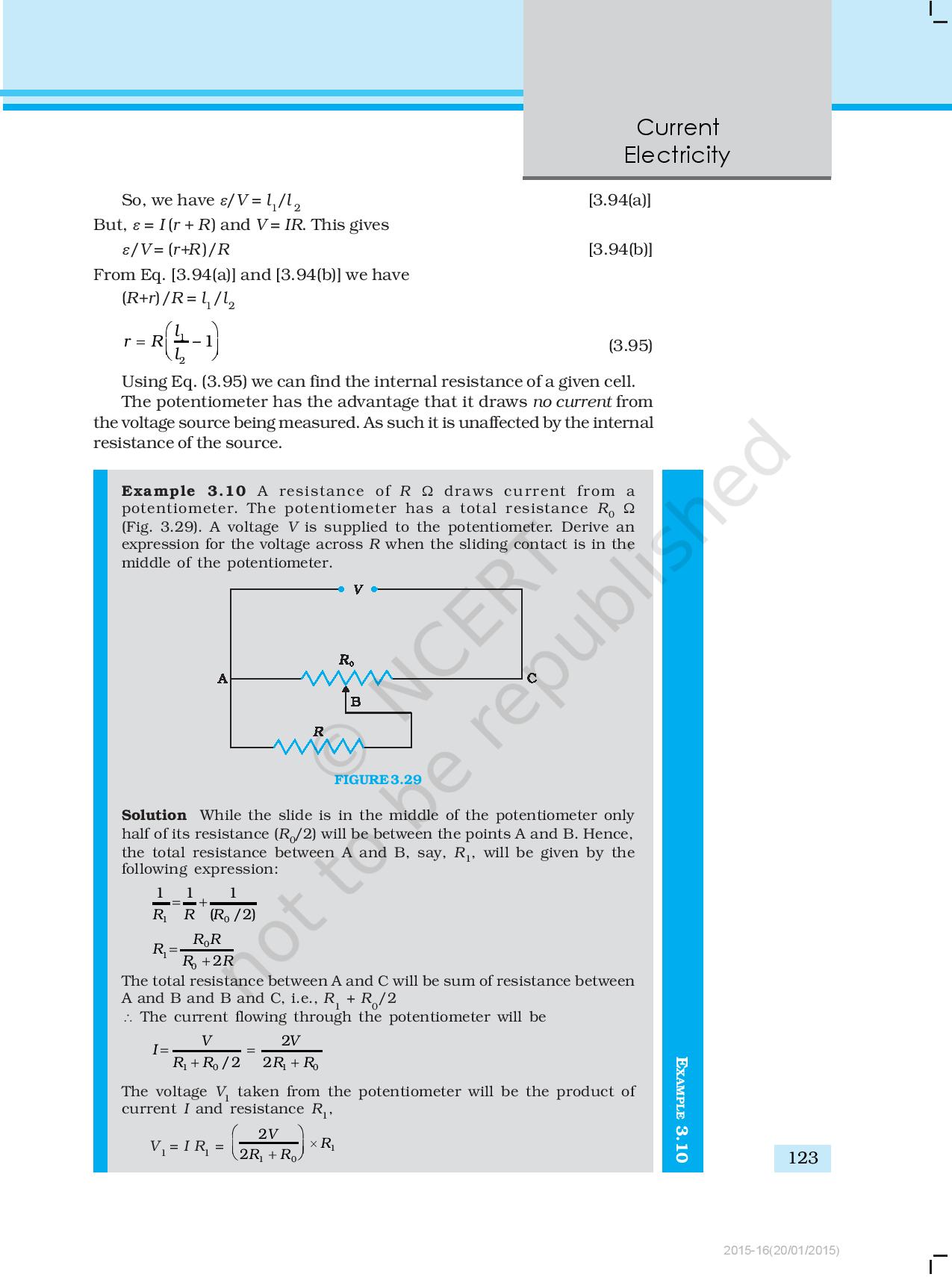
Let's break down the problem step by step to derive the expression for the voltage across the resistance R when the sliding contact is in the middle of the potentiometer. This will involve understanding the basic principles of circuits, particularly how a potentiometer works.
Understanding the Potentiometer Setup
A potentiometer is a three-terminal resistor with a sliding contact that allows us to adjust the resistance and, consequently, the voltage across it. In this scenario, we have:
- R: The resistance across which we want to find the voltage.
- R0: The total resistance of the potentiometer.
- V: The total voltage supplied to the potentiometer.
Position of the Sliding Contact
When the sliding contact is in the middle of the potentiometer, it divides the total resistance into two equal parts. Thus, each part of the potentiometer has a resistance of:
R1 = R2 = R0 / 2
Applying Ohm's Law
According to Ohm's Law, the voltage across a resistor is given by:
V = I × R
Where I is the current flowing through the resistor and R is the resistance. In our case, we need to find the current flowing through the resistance R when the sliding contact is in the middle.
Current Through the Potentiometer
The total current flowing through the potentiometer can be calculated using the total resistance and the supplied voltage:
I_total = V / R0
Since the sliding contact divides the potentiometer into two equal halves, the current through each half (R1 and R2) will be the same, and thus:
I_half = I_total / 2 = (V / R0) / 2 = V / (2R0)
Voltage Across the Resistance R
Now, we can find the voltage across the resistance R using Ohm's Law. The voltage across R can be expressed as:
V_R = I_half × R
Substituting the expression for I_half we derived earlier:
V_R = (V / (2R0)) × R
Final Expression
Thus, the voltage across the resistance R when the sliding contact is in the middle of the potentiometer can be expressed as:
V_R = (V × R) / (2R0)
This equation shows how the voltage across the resistance R is directly proportional to the supplied voltage V and the resistance R, while inversely proportional to the total resistance R0 of the potentiometer. This relationship is crucial in understanding how potentiometers can be used to control voltage in various applications.