

Grade 12Electric Current
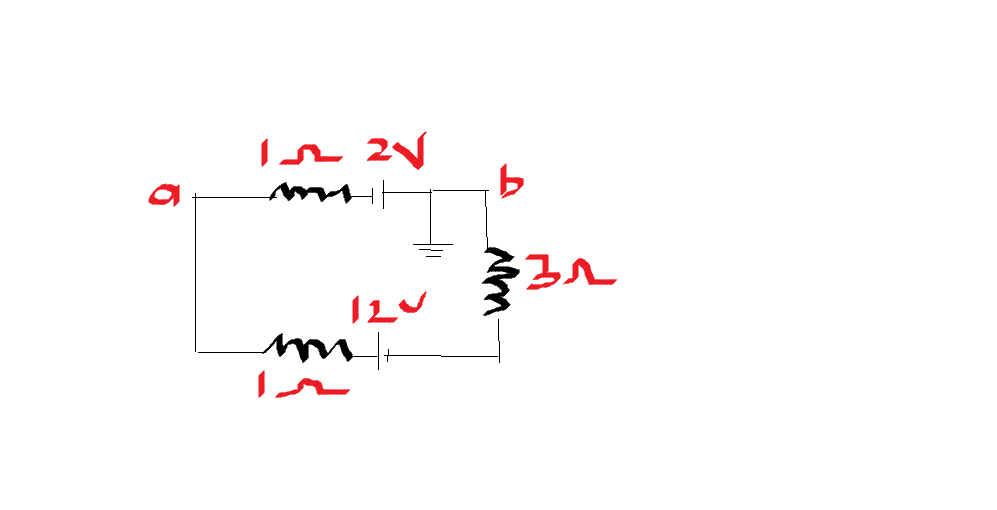
find Va-Vb in given electrical circuit. please show all steps
find Va-Vb in given electrical circuit. please show all steps


 Approved Tutor Answer11 Months ago
To find the voltage difference between two points, Va and Vb, in an electrical circuit, we need to analyze the circuit components and their arrangement. This process typically involves applying Ohm's Law, Kirchhoff's Voltage Law, and possibly other circuit analysis techniques. Let’s break down the steps clearly.
First, take a close look at the circuit diagram. Identify all the components, such as resistors, voltage sources, and any other elements that may affect the voltage between points A and B. Label these components for clarity.
Assume we have a simple series circuit with a voltage source of 12V and two resistors, R1 = 4Ω and R2 = 6Ω.
Ohm's Law states that V = IR, where V is voltage, I is current, and R is resistance. To find the current flowing through the circuit, we first need to calculate the total resistance.
In a series circuit, the total resistance (R_total) is simply the sum of the individual resistances:
R_total = R1 + R2 = 4Ω + 6Ω = 10Ω
Now, we can find the current (I) using the total voltage (V1) and the total resistance:
I = V / R_total = 12V / 10Ω = 1.2A
Next, we need to find the voltage drop across each resistor using Ohm's Law again.
V_R1 = I * R1 = 1.2A * 4Ω = 4.8V
V_R2 = I * R2 = 1.2A * 6Ω = 7.2V
Now that we have the voltage drops, we can find the voltages at points A and B. Assuming point A is at the positive terminal of the voltage source and point B is after R1:
Since point A is connected directly to the voltage source:
Va = V1 = 12V
Point B is after R1, so we subtract the voltage drop across R1 from Va:
Vb = Va - V_R1 = 12V - 4.8V = 7.2V
Finally, to find the voltage difference between points A and B (Va - Vb):
Va - Vb = 12V - 7.2V = 4.8V
In this example, the voltage difference between points A and B is 4.8V. This process can be applied to more complex circuits as well, using similar principles and techniques. Always remember to analyze the circuit step by step, keeping track of your calculations and the relationships between components.

Last Activity: 3 Years ago
Last Activity: 4 Years ago
Last Activity: 4 Years ago
Last Activity: 4 Years ago
Last Activity: 4 Years ago