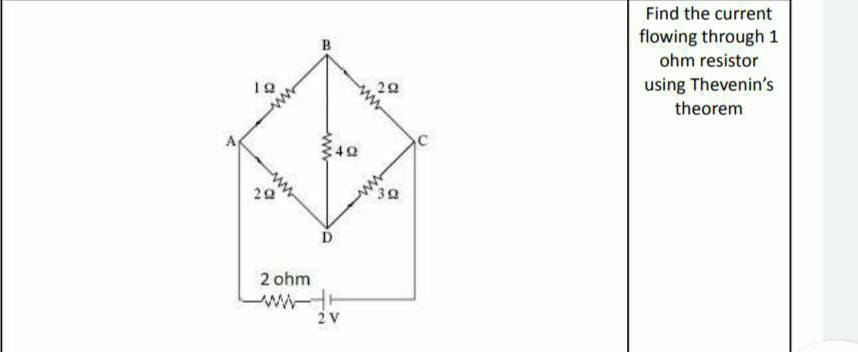
To find the current through a 1-ohm resistor using Thevenin's theorem, we first need to simplify the circuit into a Thevenin equivalent circuit. This involves determining the Thevenin voltage (Vth) and Thevenin resistance (Rth) as seen from the terminals of the resistor. Let’s break this down step by step.
Step 1: Identify the Circuit
Before applying Thevenin's theorem, ensure you have a clear circuit diagram. Identify the components connected to the 1-ohm resistor, including any voltage sources, current sources, and other resistors.
Step 2: Remove the Load Resistor
To find the Thevenin equivalent, temporarily remove the 1-ohm resistor from the circuit. This allows us to analyze the rest of the circuit without the load affecting our calculations.
Step 3: Calculate Thevenin Voltage (Vth)
To find Vth, you need to determine the open-circuit voltage across the terminals where the 1-ohm resistor was connected. This can be done using voltage division or mesh analysis, depending on the complexity of the circuit. For example, if you have a simple series circuit with a voltage source and resistors, you can apply the voltage divider rule:
- If V is the total voltage and R1 is the resistor connected in series with the load, then:
- Vth = V * (R1 / (R1 + R2))
Step 4: Calculate Thevenin Resistance (Rth)
Next, to find Rth, turn off all independent sources in the circuit. For voltage sources, replace them with a short circuit, and for current sources, replace them with an open circuit. Then, calculate the equivalent resistance seen from the terminals where the 1-ohm resistor was connected. This can often be done using series and parallel resistance formulas:
- For resistors in series: R_total = R1 + R2 + ...
- For resistors in parallel: 1/R_total = 1/R1 + 1/R2 + ...
Step 5: Reconnect the Load Resistor
Now that you have Vth and Rth, you can reconnect the 1-ohm resistor to the Thevenin equivalent circuit, which consists of Vth in series with Rth and the 1-ohm resistor.
Step 6: Calculate the Current (I)
Using Ohm's law, you can now find the current through the 1-ohm resistor. The total resistance in the circuit is Rth + 1 ohm. The current can be calculated as:
I = Vth / (Rth + 1)
Example Calculation
Let’s say you found Vth to be 10 volts and Rth to be 2 ohms. Plugging these values into the current formula gives:
I = 10 / (2 + 1) = 10 / 3 ≈ 3.33 A
This means the current flowing through the 1-ohm resistor is approximately 3.33 amperes.
Final Thoughts
Thevenin's theorem is a powerful tool for simplifying complex circuits, making it easier to analyze the behavior of specific components. By following these steps, you can effectively determine the current through any resistor in a circuit. If you have a specific circuit in mind, feel free to share, and we can work through it together!