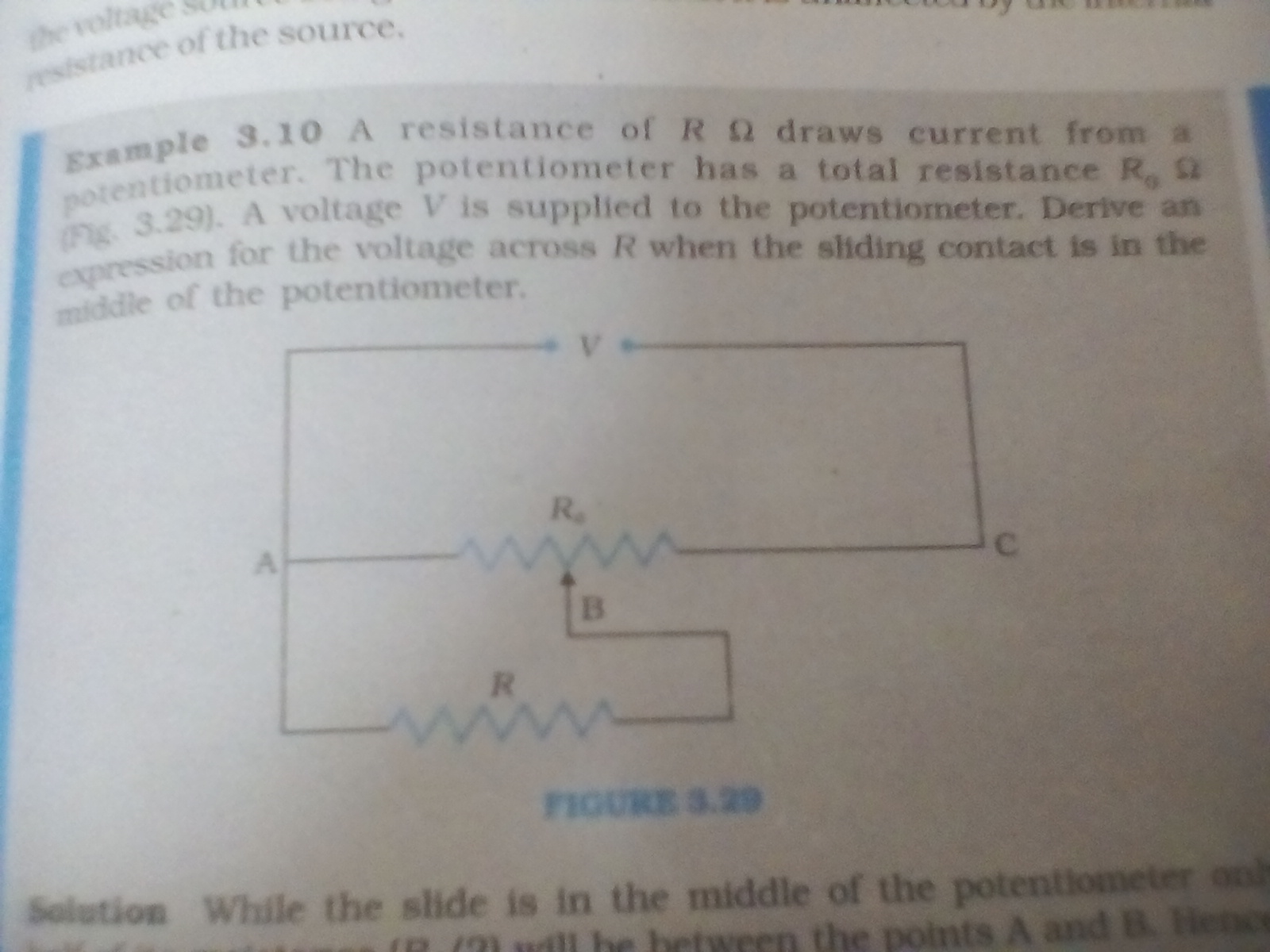
To derive the expression for the voltage across a resistance R when the sliding contact of a potentiometer is positioned in the middle, we first need to understand how a potentiometer operates and the relationship between voltage, resistance, and current in this context.
Understanding the Potentiometer Setup
A potentiometer essentially consists of a uniform resistive wire of length L with a sliding contact (often called a jockey). When a voltage V is applied across the ends of the potentiometer, it creates a potential gradient along the length of the wire. The voltage drop per unit length is constant, given by:
- Voltage drop per unit length: V/L
Positioning the Sliding Contact
When the sliding contact is in the middle of the potentiometer, it divides the total length L into two equal halves. Thus, each half measures L/2. The voltage drop across each half can be calculated as follows:
- Voltage across the first half: (V/L) * (L/2) = V/2
- Voltage across the second half: (V/L) * (L/2) = V/2
Calculating the Voltage Across R
Assuming that the resistance R is connected across the sliding contact, the voltage across R when the sliding contact is in the middle of the potentiometer is simply the voltage drop across that section of the wire. Since the sliding contact is in the middle, the voltage across R is:
Conclusion
Therefore, when the sliding contact is positioned centrally, the expression for the voltage across the resistance R is:
This indicates that half of the total applied voltage V is available across the resistance R at this midpoint position. This principle is crucial in many practical applications, including measuring and calibrating voltages in circuits.