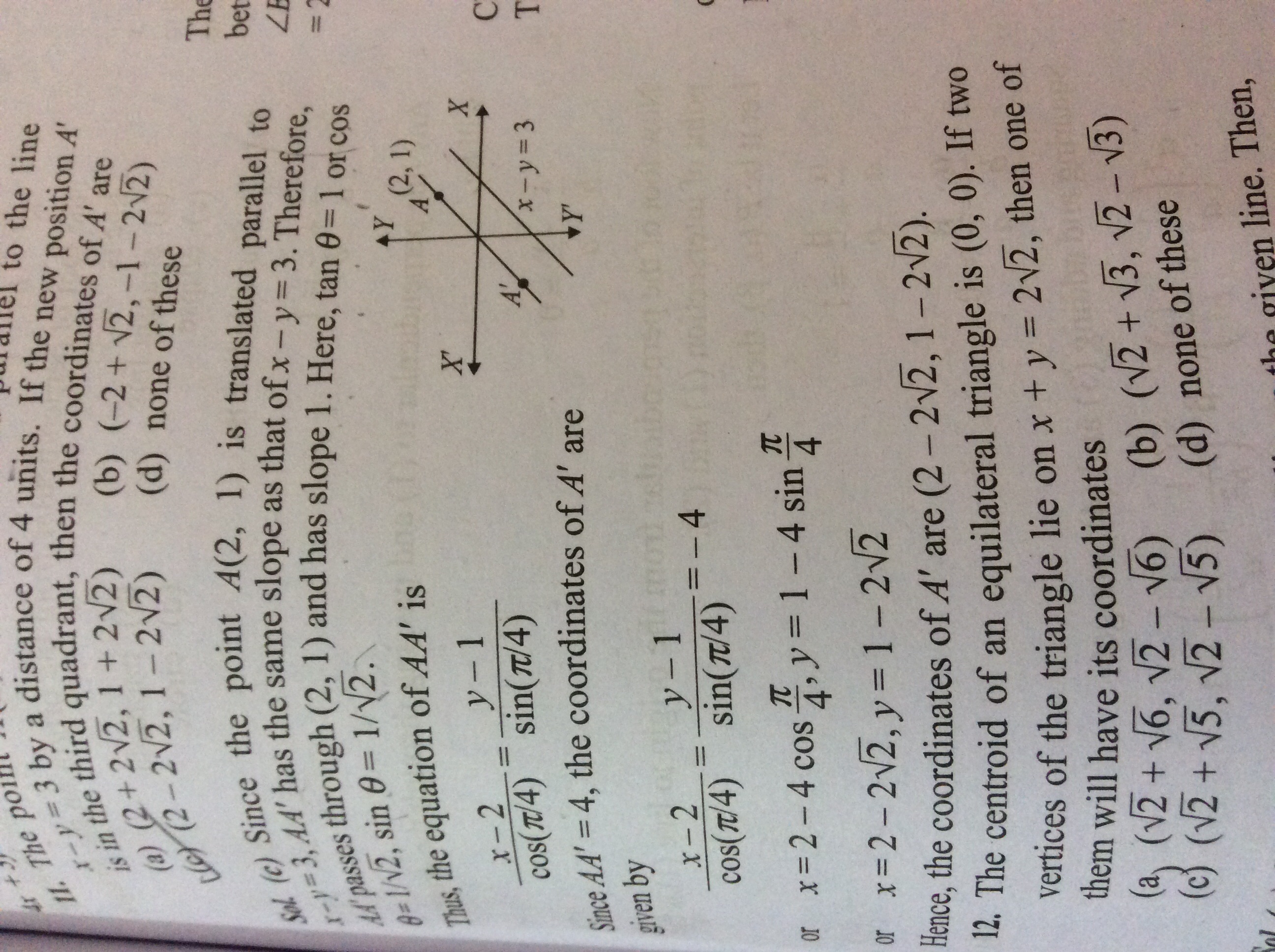
To find the coordinates of one vertex of an equilateral triangle given that its centroid is at (0,0) and two of its vertices lie on the line represented by the equation x + y = 2√2, we can approach this problem step by step.
Understanding the Centroid of a Triangle
The centroid of a triangle is the point where all three medians intersect, and it is also the average of the vertices' coordinates. For a triangle with vertices A(x1, y1), B(x2, y2), and C(x3, y3), the coordinates of the centroid (G) can be calculated as:
- Gx = (x1 + x2 + x3) / 3
- Gy = (y1 + y2 + y3) / 3
In our case, since the centroid is at (0,0), we have:
- 0 = (x1 + x2 + x3) / 3
- 0 = (y1 + y2 + y3) / 3
Setting Up the Problem
Let’s denote the two vertices on the line x + y = 2√2 as A(x1, y1) and B(x2, y2). The third vertex C(x3, y3) will be determined based on the properties of the centroid. Since the centroid is at (0,0), we can express the coordinates of C in terms of A and B:
- x3 = - (x1 + x2)
- y3 = - (y1 + y2)
Finding the Vertices
Since points A and B lie on the line x + y = 2√2, we can express y1 and y2 in terms of x1 and x2:
- y1 = 2√2 - x1
- y2 = 2√2 - x2
Substituting these values into the equations for the centroid gives us:
- 0 = (x1 + x2 - (2√2 - x1) - (2√2 - x2)) / 3
Rearranging this, we find:
- 0 = (x1 + x2 - 2√2 + x1 - 2√2 + x2) / 3
- 0 = (2x1 + 2x2 - 4√2) / 3
Simplifying the Equation
Multiplying through by 3 gives:
This simplifies to:
Finding One Vertex
Now, we can choose a specific value for x1 to find the corresponding y1 and then use x2 = 2√2 - x1 to find y2. Let’s choose x1 = √2:
This gives us the coordinates for vertex A:
Now, using x2 = 2√2 - √2 = √2, we have:
However, since we need distinct vertices, let’s choose another value for x1, say x1 = 2√2 - 1:
This gives us:
Now, we can find B using x2 = 1:
Final Vertex Calculation
The third vertex C can now be calculated as:
- x3 = -((2√2 - 1) + 1) = -2√2 + 1
- y3 = -((1) + (2√2 - 1)) = -2√2
Conclusion
Thus, we have one of the vertices as A(2√2 - 1, 1) or you could choose A(1, 2√2 - 1) depending on your choice of x1. Both satisfy the conditions laid out by the problem.