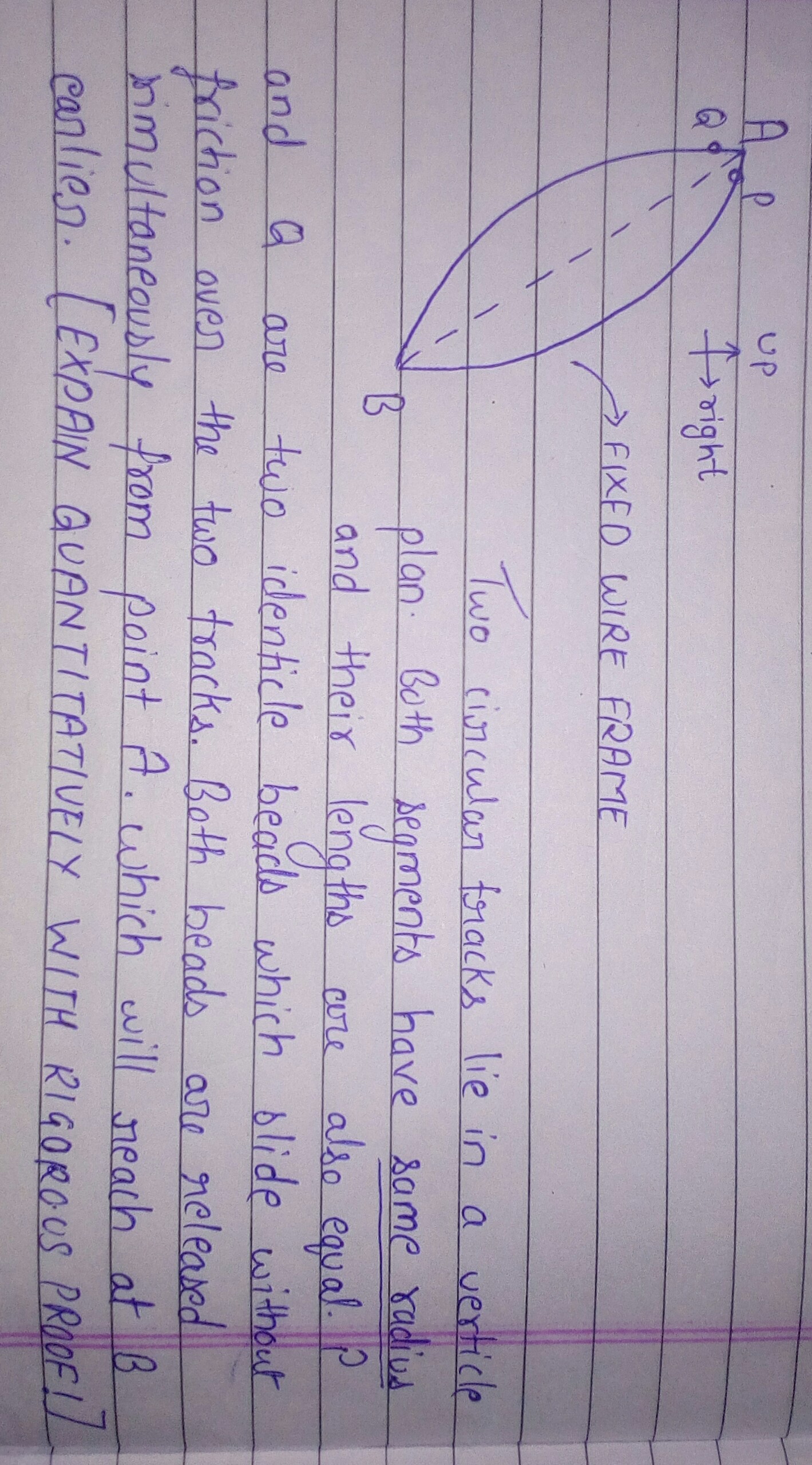
To provide a quantitative proof related to the Brachistochrone problem, we need to delve into the physics of motion and calculus. The Brachistochrone curve is the path of quickest descent between two points under the influence of gravity, and it is a fascinating example of the application of calculus of variations. Let's break this down step by step.
The Brachistochrone Problem Defined
The problem can be stated as follows: Given two points A and B, where point A is higher than point B, what is the shape of the curve along which a particle will slide from A to B in the least time, assuming no friction and that the only force acting on the particle is gravity?
Mathematical Formulation
To derive the Brachistochrone curve, we start with the principles of physics and calculus. The time \( T \) taken to slide along a curve can be expressed as:
- Let \( y(x) \) be the curve, where \( y \) is the vertical position and \( x \) is the horizontal position.
- The time \( T \) to travel from point A to point B can be expressed as:
\( T = \int_{A}^{B} \frac{ds}{v}
\end{p}
where \( ds \) is the differential arc length and \( v \) is the velocity of the particle.
Velocity and Energy Considerations
Using conservation of energy, we can relate the velocity \( v \) to the height \( y \) of the particle:
\( v = \sqrt{2gy}
\end{p}
where \( g \) is the acceleration due to gravity. The arc length \( ds \) can be expressed in terms of \( dx \) and \( dy \) as:
\( ds = \sqrt{1 + \left(\frac{dy}{dx}\right)^2} dx
\end{p}
Substituting these into the time integral gives us:
\( T = \int_{A}^{B} \frac{\sqrt{1 + \left(\frac{dy}{dx}\right)^2}}{\sqrt{2gy}} dx
\end{p}
Applying Calculus of Variations
To find the curve that minimizes the time \( T \), we apply the calculus of variations. We need to minimize the functional:
\( J[y] = \int_{y_1}^{y_2} F(y, y', x) dx
\end{p}
where \( F(y, y', x) = \frac{\sqrt{1 + (y')^2}}{\sqrt{2gy}} \) and \( y' = \frac{dy}{dx} \).
Using the Euler-Lagrange equation, we derive the necessary conditions for \( y(x) \). The resulting differential equation leads us to the conclusion that the optimal path is a cycloid, which can be parametrized as:
- \( x = r(\theta - \sin \theta) \)
- \( y = r(1 - \cos \theta) \)
Conclusion: The Cycloid as the Brachistochrone
Through this derivation, we find that the Brachistochrone curve is indeed a cycloid. This means that if you were to release a particle from point A, it would follow this path to point B in the shortest time possible. The beauty of this problem lies not only in its mathematical elegance but also in its implications for physics and engineering, demonstrating the power of calculus in solving real-world problems.