

Grade 10Algebra
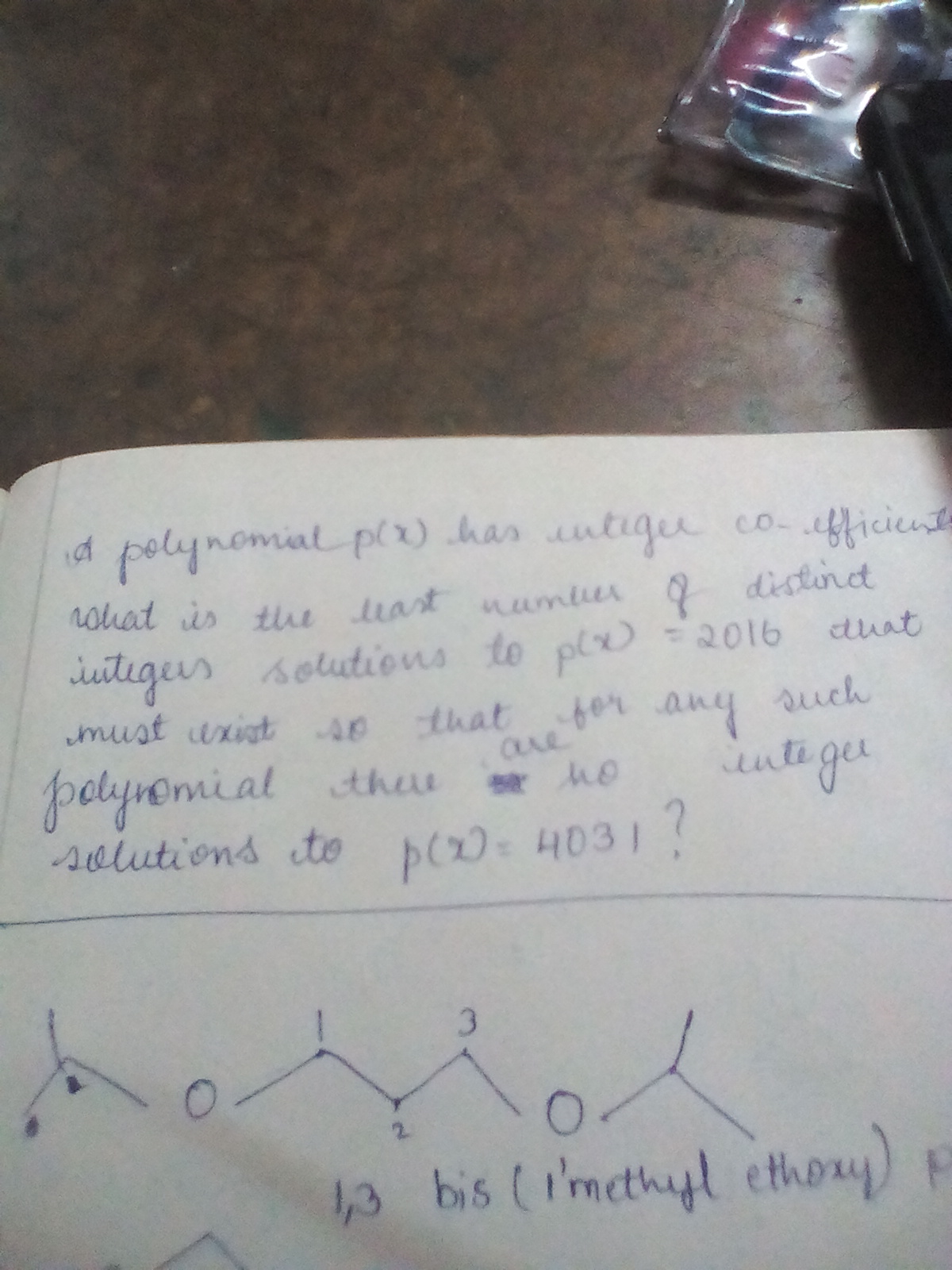
This is a question related to polynomials and also an Olympiad question
This is a question related to polynomials and also an Olympiad question


 Approved Tutor Answer1 Year ago
Polynomials are fascinating mathematical expressions that can often lead to intriguing problems, especially in competitive settings like Olympiads. Let’s delve into a common type of question you might encounter involving polynomials, focusing on their properties and behaviors.
A polynomial is an expression made up of variables raised to non-negative integer powers, combined using addition, subtraction, and multiplication. For example, the expression 2x^3 - 4x^2 + 3x - 5 is a polynomial of degree 3. The degree of a polynomial is determined by the highest power of the variable present.
When tackling Olympiad-style questions, it’s essential to apply various techniques. Here’s a structured approach:
Is it asking for roots, factoring, or evaluating the polynomial at a specific point? Understanding what is required is the first step.
If you need to find the value of a polynomial at a certain point, the Remainder Theorem can be very helpful. It states that when a polynomial f(x) is divided by (x - c), the remainder is f(c). This can simplify calculations significantly.
Many problems require you to factor polynomials. Techniques include:
Consider the polynomial f(x) = x^3 - 6x^2 + 11x - 6. Let’s find its roots.
This theorem suggests that any rational root, in the form of p/q, must be a factor of the constant term (here, -6) over a factor of the leading coefficient (here, 1). The possible rational roots are ±1, ±2, ±3, ±6.
By substituting these values into the polynomial, we find:
Since we found the roots, we can express the polynomial as:
f(x) = (x - 1)(x - 2)(x - 3)
Polynomials are not just theoretical constructs; they have practical applications in various fields, including physics, engineering, and economics. Mastering their properties and solving techniques can greatly enhance your problem-solving skills, especially in competitive environments. Keep practicing, and you'll find these concepts becoming second nature!

Last Activity: 2 Years ago