
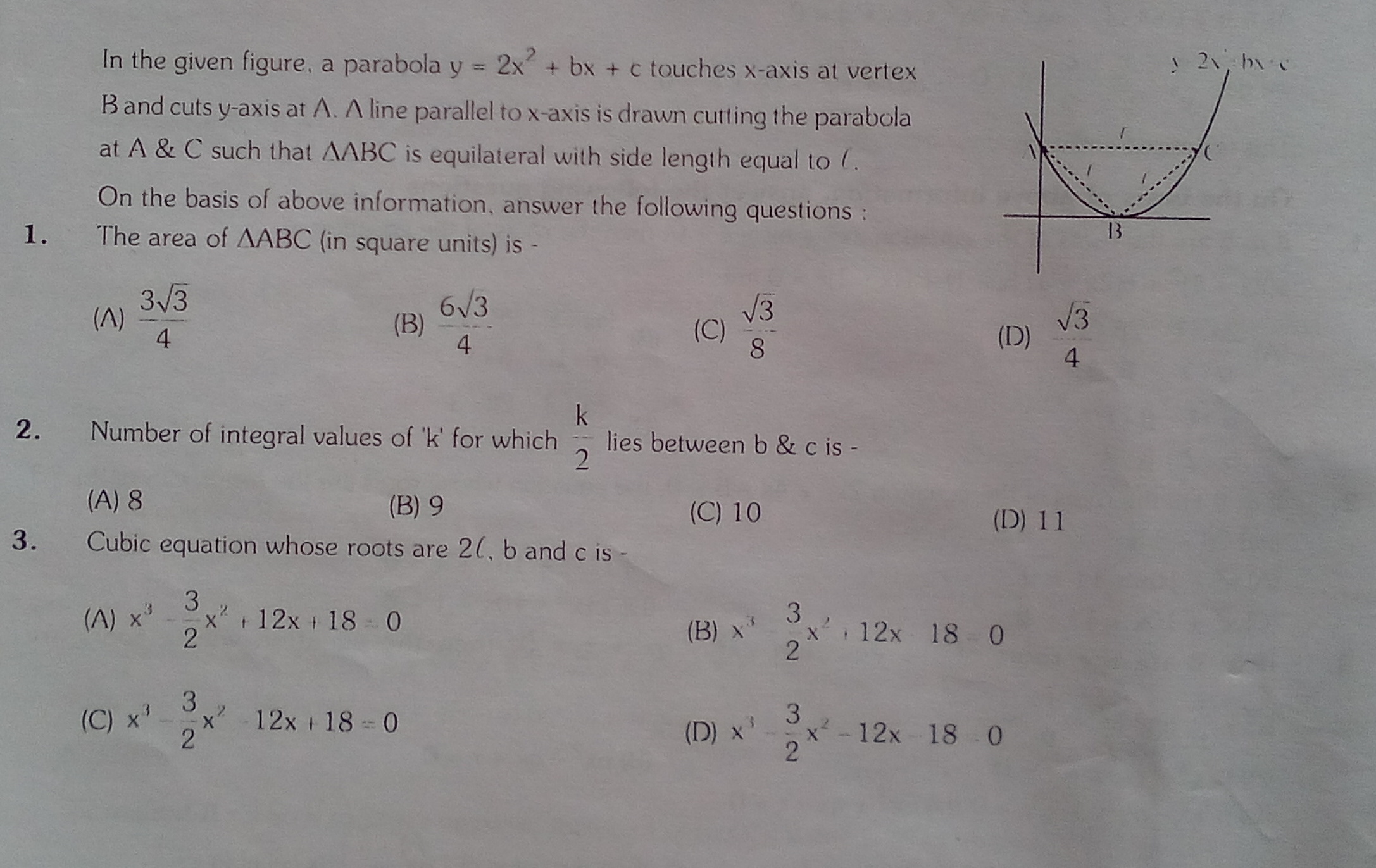
solve the question given in the attachment .........
solve the question given in the attachment
..
.
.
.
.
.
.
.

Ravneet , 7 Years ago
Grade 12th Pass
 Algebra> solve the question given in the attachmen...
 1 Answers
It seems like there might be a misunderstanding, as I can't view attachments directly. However, I can certainly help you solve a problem if you describe it to me! Just provide the details of the question, and I’ll guide you through the solution step by step.
When tackling a question, the first step is to clearly understand what is being asked. This often involves identifying key components of the problem, such as:
Let’s say your question involves solving a quadratic equation, such as \( ax^2 + bx + c = 0 \). Here’s how you would approach it:
First, identify the values of \( a \), \( b \), and \( c \) from your equation. For instance, in the equation \( 2x^2 + 4x - 6 = 0 \), you have:
The quadratic formula is given by:
\( x = \frac{-b \pm \sqrt{b^2 - 4ac}}{2a} \)
Substituting the values of \( a \), \( b \), and \( c \) into this formula will allow you to find the roots of the equation.
The discriminant \( D \) is calculated as \( b^2 - 4ac \). This value will help determine the nature of the roots:
Once you have the discriminant, plug it back into the quadratic formula to find the values of \( x \). For our example:
By breaking down the problem into manageable steps and applying the appropriate formulas, you can effectively solve a variety of mathematical questions. If you provide the specifics of your question, I can tailor this approach to fit your needs perfectly!
 Approved
Prepraring for the competition made easy just by live online class.

Full Live Access

Study Material

Live Doubts Solving

Daily Class Assignments

Last Activity: 2 Years ago
Last Activity: 2 Years ago
Last Activity: 3 Years ago