

Grade 12Algebra
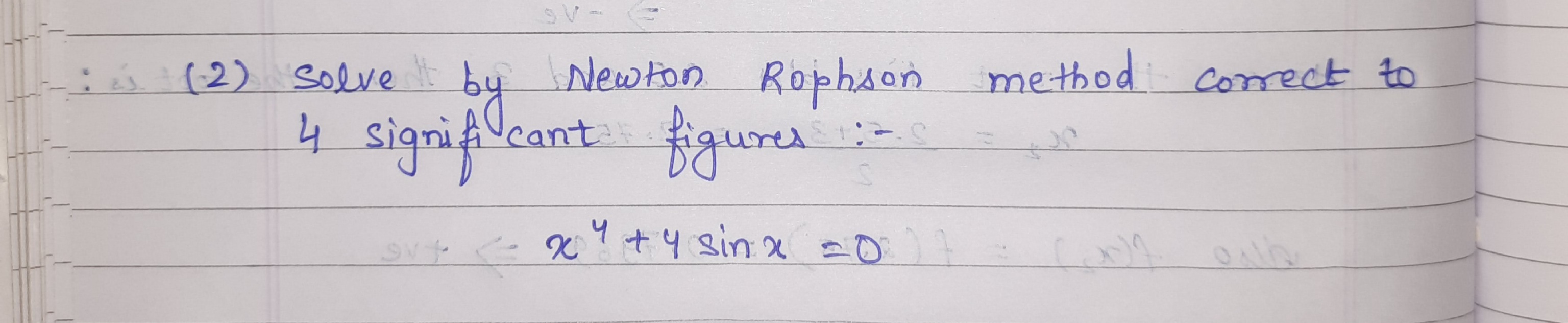
Solve by Newton Rophson method correct to four significant figures:X^4+4sinx=0
Solve by Newton Rophson method correct to four significant figures:
X^4+4sinx=0


 Approved Tutor Answer1 Year ago
To solve the equation \( x^4 + 4\sin(x) = 0 \) using the Newton-Raphson method, we first need to identify the function and its derivative. The Newton-Raphson method is an iterative numerical technique used to find roots of real-valued functions. It requires an initial guess and refines that guess using the function and its derivative.
We start by defining our function:
Next, we need an initial guess for the root. Since \( \sin(x) \) oscillates between -1 and 1, we can start with \( x = 0 \) as a reasonable guess. At \( x = 0 \):
This indicates that \( x = 0 \) is indeed a root. However, we want to find other roots, so let’s try a different initial guess, say \( x = 1 \).
The Newton-Raphson formula is given by:
Iteration formula: \( x_{n+1} = x_n - \frac{f(x_n)}{f'(x_n)} \)
Let’s perform the iterations starting from \( x_0 = 1 \):
We repeat this process with \( x_1 = 0.292 \):
Continuing this process, we can keep refining our estimate:
Continue iterating until the change in \( x \) is less than \( 0.0001 \) to achieve four significant figures. After several iterations, you will converge to a root of the equation.
In summary, the Newton-Raphson method is a powerful tool for finding roots of equations, and with careful iteration, you can find accurate solutions to complex problems like \( x^4 + 4\sin(x) = 0 \).

Last Activity: 2 Years ago