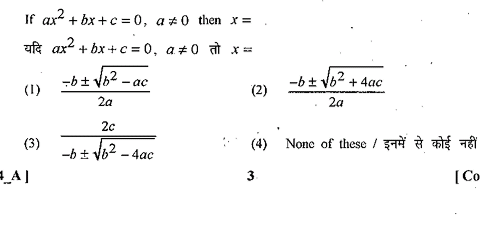
ax2 + bx+c=0
x2 + (b/a) x + (c/a) = 0 (Dividing by a)
x2 + 2 * (b/2a) * x + (c/a) = 0 (Dividing and multiplying by 2 in the second term of the equation.)
x2 +2 * (b/2a) * x + (b/2a)2 -(b/2a)2 + (c/a) = 0 (Making the eqation perfect square by adding and substracting (b/2a)2 )
[ x + (b/2a) ]2 – b2/4a2 + c/a = 0
[ x + (b/2a)]2 = b2/4a – c/a
[ x + (b/2a)]2 = (b2 - 4ac) / 4a2
[ x + (b/2a)] =+-[ (b2 – 4ac) / 4a2] ½
[ x + (b/2a)] = ± [(b2 -4ac)1/2 ] / (2a)
x = -b/2a +-(b2 -4ac)½ /2a
x = [-b ± (b2 -4ac)1/2 ] / 2a
Therefore the anser is (d) None of these