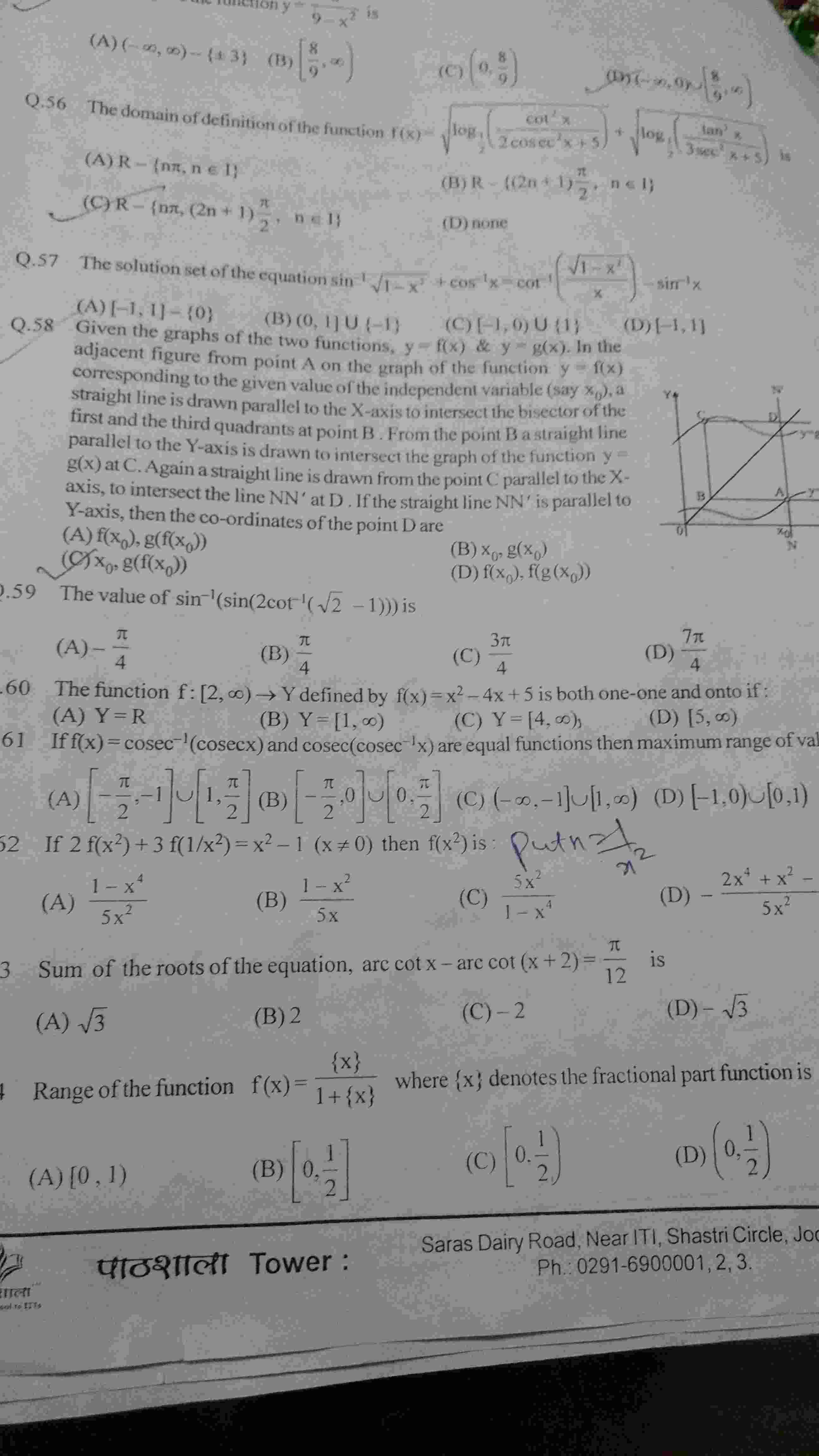
Let's dive into each of your questions one by one, starting with the first one regarding the function f(x) = {x} + 1 + {x}, where { } denotes the fractional part function.
Finding the Range of f(x) = {x} + 1 + {x}
The fractional part function, denoted as {x}, is defined as {x} = x - ⌊x⌋, where ⌊x⌋ is the greatest integer less than or equal to x. This means that {x} always yields a value in the interval [0, 1). Now, let's break down the function f(x).
Breaking Down the Function
We can rewrite f(x) as follows:
- f(x) = {x} + 1 + {x} = 2{x} + 1
Since {x} ranges from 0 to just below 1, we can substitute this into our function:
Calculating the Range
When {x} = 0, f(x) becomes:
When {x} approaches 1 (but never actually reaches it), f(x) approaches:
Thus, the function f(x) takes values in the interval [1, 3) as {x} varies from 0 to just below 1. Therefore, the range of f(x) is:
[1, 3)
Solving the Equation 2f(x²) + 3f(1 + x²) = x² - 1
Now, let's tackle your second question regarding the equation 2f(x²) + 3f(1 + x²) = x² - 1, where x is not equal to 0. We need to find f(x²).
Analyzing the Equation
To find f(x²), we can assume a form for f(x) and see if it fits the equation. A common approach is to assume that f(x) is a linear function, say f(x) = ax + b. However, without loss of generality, let's analyze the structure of the equation.
Substituting Values
Let's substitute x² into the function:
- Let y = x², then the equation becomes 2f(y) + 3f(1 + y) = y - 1.
Now, we can express f(y) and f(1 + y) in terms of y. If we assume f(y) = ky + c, we can substitute this into our equation:
Setting Up the System
Substituting gives:
- 2(ky + c) + 3(k(1 + y) + c) = y - 1
Expanding this leads to:
- 2ky + 2c + 3ky + 3k + 3c = y - 1
Combining like terms results in:
- (5k)y + (5c + 3k) = y - 1
For this to hold for all y, we equate coefficients:
- 5k = 1, which gives k = 1/5
- 5c + 3(1/5) = -1, solving gives c = -2/5
Thus, we find:
f(x) = (1/5)x - (2/5)
Conditions for One-to-One and Onto Functions
Lastly, let's discuss the function f: [2, ∞) → ℝ defined by f(x) = x² + 4x + 5. We want to determine the conditions under which this function is both one-to-one and onto.
Understanding One-to-One
A function is one-to-one if it never assigns the same value to two different domain elements. For a quadratic function like f(x), we can check its derivative:
Since f'(x) is always positive for x ≥ 2, f(x) is strictly increasing in this interval, confirming that it is one-to-one.
Exploring Onto
A function is onto if every possible output in the codomain is covered. The minimum value of f(x) occurs at x = -2, but since our domain starts at x = 2, we calculate:
- f(2) = 2² + 4(2) + 5 = 4 + 8 + 5 = 17
As x approaches infinity, f(x) also approaches infinity. Therefore, the range of f(x) is [17, ∞), which means it is onto if we restrict the codomain to [17, ∞).
In summary, f(x) is one-to-one and onto if its codomain is restricted to [17, ∞).