

Grade 12th passAlgebra
 Pls do the question by vector method and attaching the required picture whre required.DO NOT DO IT BY z=x+iy CONVENTIONAL WAY.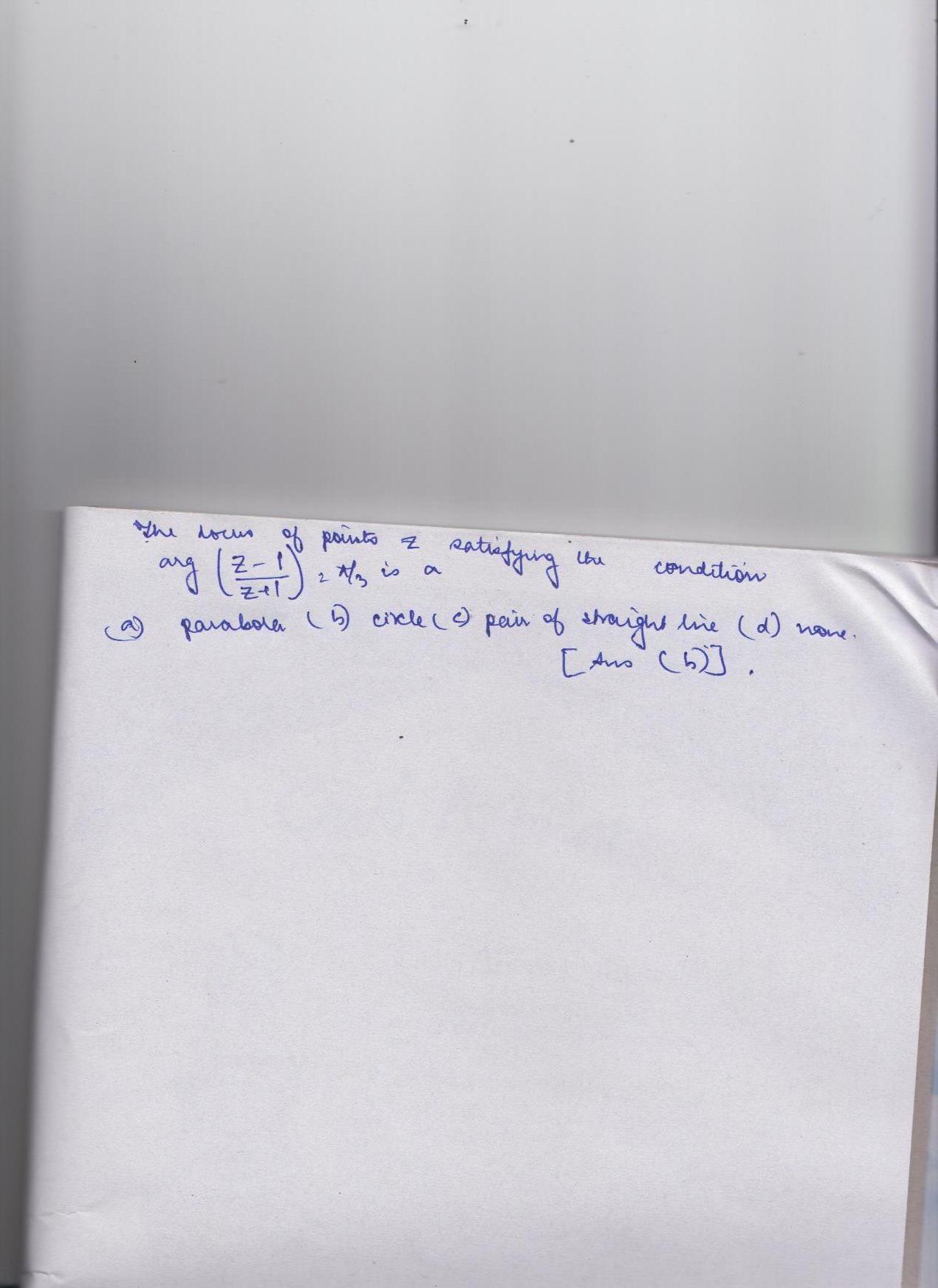
 Pls do the question by vector method and attaching the required picture whre required.DO NOT DO IT BY z=x+iy CONVENTIONAL WAY.
 Approved Tutor Answer1 Year ago
To tackle problems using the vector method, we first need to understand the fundamental concepts of vectors and how they can be applied to various scenarios. Let's break this down step by step, ensuring clarity and depth in our explanation.
Vectors are quantities that have both magnitude and direction. They can be represented graphically as arrows, where the length of the arrow indicates the magnitude and the direction of the arrow indicates the direction of the vector. In mathematical terms, a vector in a two-dimensional space can be expressed as:
Let’s consider a practical example where we need to find the resultant vector of two vectors A and B. Assume:
To find the resultant vector R, we simply add the corresponding components of the vectors:
Substituting the values:
To visualize this, imagine plotting the vectors on a Cartesian plane. Vector A starts at the origin (0,0) and points to (3,4), while Vector B starts at the origin and points to (1,2). The resultant vector R can be drawn from the origin to the point (4,6). This graphical representation helps in understanding how vectors combine.
Next, we can calculate the magnitude of the resultant vector R using the Pythagorean theorem:
Substituting the values:
The direction of the vector can be found using the tangent function:
Substituting the values:
In summary, using the vector method, we found:
This approach not only provides a clear method for solving vector problems but also enhances our understanding of how vectors interact in a two-dimensional space. If you have any specific scenarios or examples you'd like to explore further, feel free to ask!

Last Activity: 2 Years ago