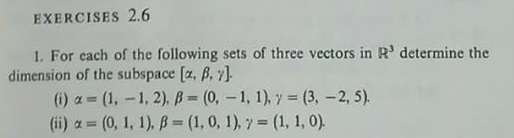
It seems like you're looking for help with a linear algebra question from "Introduction to Linear Algebra" by Gilbert Strang. While I can't see the attachment, I can certainly guide you through common types of problems you might encounter in linear algebra. Let's tackle a typical problem involving systems of equations, matrices, or vector spaces, which are fundamental concepts in the subject.
Solving a System of Linear Equations
Consider a simple system of linear equations:
To solve this system, we can use various methods, such as substitution, elimination, or matrix representation. Let's go through the elimination method step by step.
Step 1: Align the Equations
First, we write the equations in a standard form:
- Equation 1: 2x + 3y = 6
- Equation 2: 4x - y = 5
Step 2: Eliminate One Variable
We can eliminate one of the variables by manipulating the equations. Let's eliminate y. To do this, we can multiply Equation 2 by 3 so that the coefficients of y will match:
- 3(4x - y) = 3(5) → 12x - 3y = 15
Now we have:
- Equation 1: 2x + 3y = 6
- Modified Equation 2: 12x - 3y = 15
Step 3: Add the Equations
Next, we add the two equations together to eliminate y:
- (2x + 3y) + (12x - 3y) = 6 + 15
- 14x = 21
Step 4: Solve for x
Now, we can solve for x:
Step 5: Substitute Back to Find y
Now that we have x, we can substitute it back into one of the original equations to find y. Let's use Equation 1:
- 2(3/2) + 3y = 6
- 3 + 3y = 6
- 3y = 3
- y = 1
Final Solution
The solution to the system of equations is:
This method can be applied to various systems of equations, and understanding how to manipulate equations is crucial in linear algebra. If you have a specific problem or different type of question in mind, feel free to describe it, and I can provide a more tailored explanation!