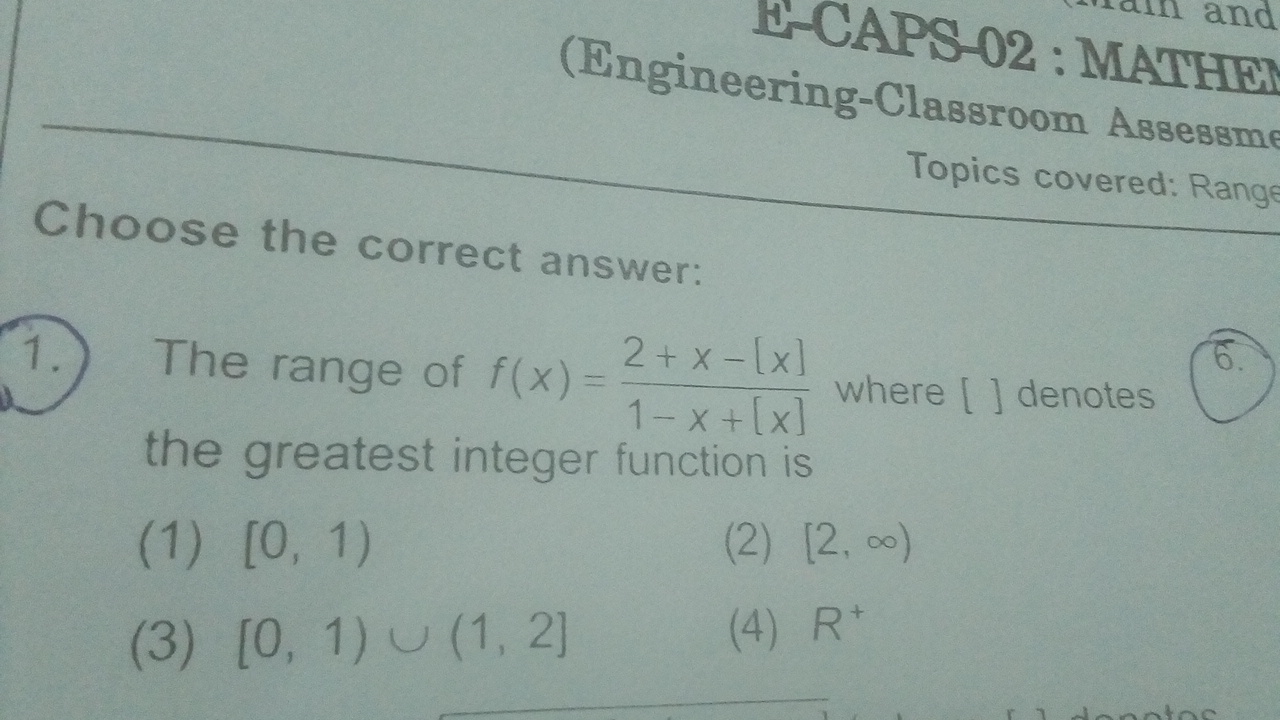
f(x) = ( 2 + x – [x] ) / (1 – x + [x] )
We know that x = [x] + {x}, where [x] and {x} denote greatest integer of x and fractional part off x respectively.
So, f(x) = ( 2 + [x] + {x} – [x] ) / ( 1 – [x] – {x} + [x] )
= ( 2 + {x} ) / ( 1 – {x} )
Let y be any general value of f(x) corresponding to some x.

y = ( 2 + {x} ) / ( 1 – {x} )
y – y {x} = 2 + {x} ; (y + 1) . {x} = y – 2
So {x} = (y – 2) / (y + 1)
Also, we know that 0

{x}

1 . So,
Hence, 0
(y – 2) / (y + 1)
1 , which implies
y – 2

0 i.e. y
2 …......................(1)
or y – 2
y + 1 i.e. – 2
1, which is true for all y

R …............... (2)
Taking intersection of (1) & (2), we get
y
[ 2 , infinity)
Range of f(x) is [ 2 , infinity) 



 Approved Tutor Answer8 Years ago