

Grade 12th passMechanics
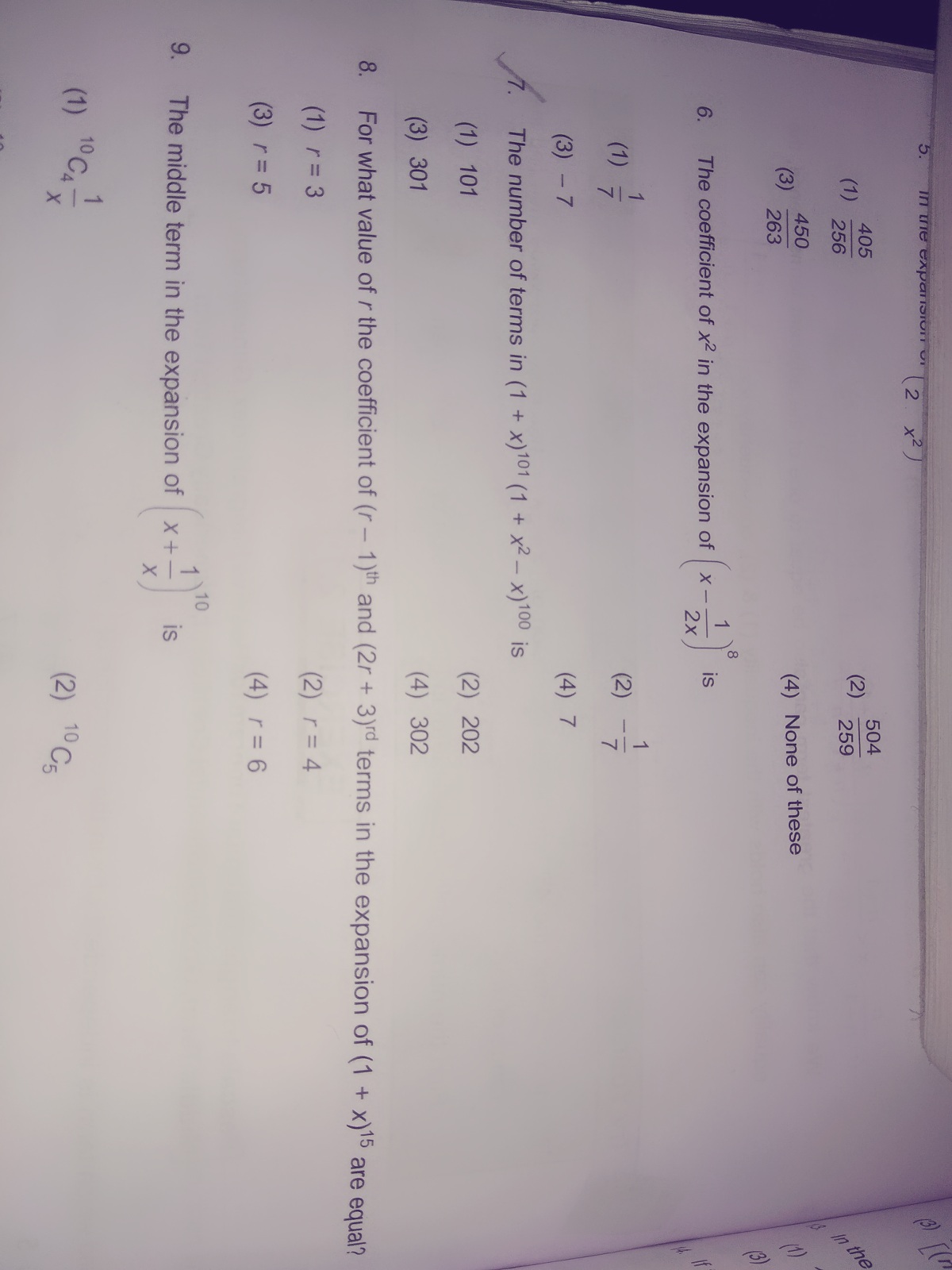
Please answer 7 and 8 And Q-8 with explanation This question is from binomial theorem


 Approved Tutor Answer1 Year ago
Let's dive into the concepts related to the binomial theorem, particularly focusing on questions 7 and 8. The binomial theorem provides a powerful way to expand expressions of the form (a + b)^n, where n is a non-negative integer. This theorem is not just a formula; it has practical applications in algebra, probability, and even calculus.
For question 7, you might be asked to expand an expression like (x + y)^5. To do this using the binomial theorem, we can apply the formula:
(a + b)^n = Σ (n choose k) * a^(n-k) * b^k, where k ranges from 0 to n.
In our case, a = x, b = y, and n = 5. The binomial coefficients, often denoted as "n choose k" or C(n, k), can be calculated using the formula:
C(n, k) = n! / (k!(n-k)!)
Now, let's expand (x + y)^5:
Putting it all together, we get:
(x + y)^5 = x^5 + 5x^4y + 10x^3y^2 + 10x^2y^3 + 5xy^4 + y^5
Now, let's tackle question 8, which often involves finding a specific coefficient in the expansion of a binomial expression. For example, if you need to find the coefficient of x^3y^2 in the expansion of (x + y)^5, you can use the same binomial theorem approach.
To find the coefficient of x^3y^2, we identify that this corresponds to k = 2 (since y is raised to the power of 2). The exponent of x will then be 5 - 2 = 3. Using the binomial coefficient:
C(5, 2) = 5! / (2!(5-2)!) = 10
Thus, the coefficient of x^3y^2 in the expansion of (x + y)^5 is:
10 * x^3 * y^2
So, the coefficient is 10.
Understanding these concepts not only helps with binomial expansions but also lays the groundwork for more advanced topics in algebra and combinatorics. If you have further questions or need clarification on any part, feel free to ask!

Three identical balls are placed on a frictionless
horizontal surface touching each other. They stick to
each other because of adhesive. Another ball of same
radius and mass m is placed over the void created by
the three balls. Find the forces applied by the balls
kept on the floor to each other if the system remains
in equilibrium.
Last Activity: 10 Months ago
A car loaded with water having total mass 1000 kg moves on a straight horizontal Road starting from rest under the action of a force of 100 Newton. The water spills throw a small hole in the bottom at a rate of 0.1 KG per second the velocity of cart after 300 seconds is nearly.
11
21
31
41
Last Activity: 10 Months ago
Last Activity: 3 Years ago
Last Activity: 3 Years ago