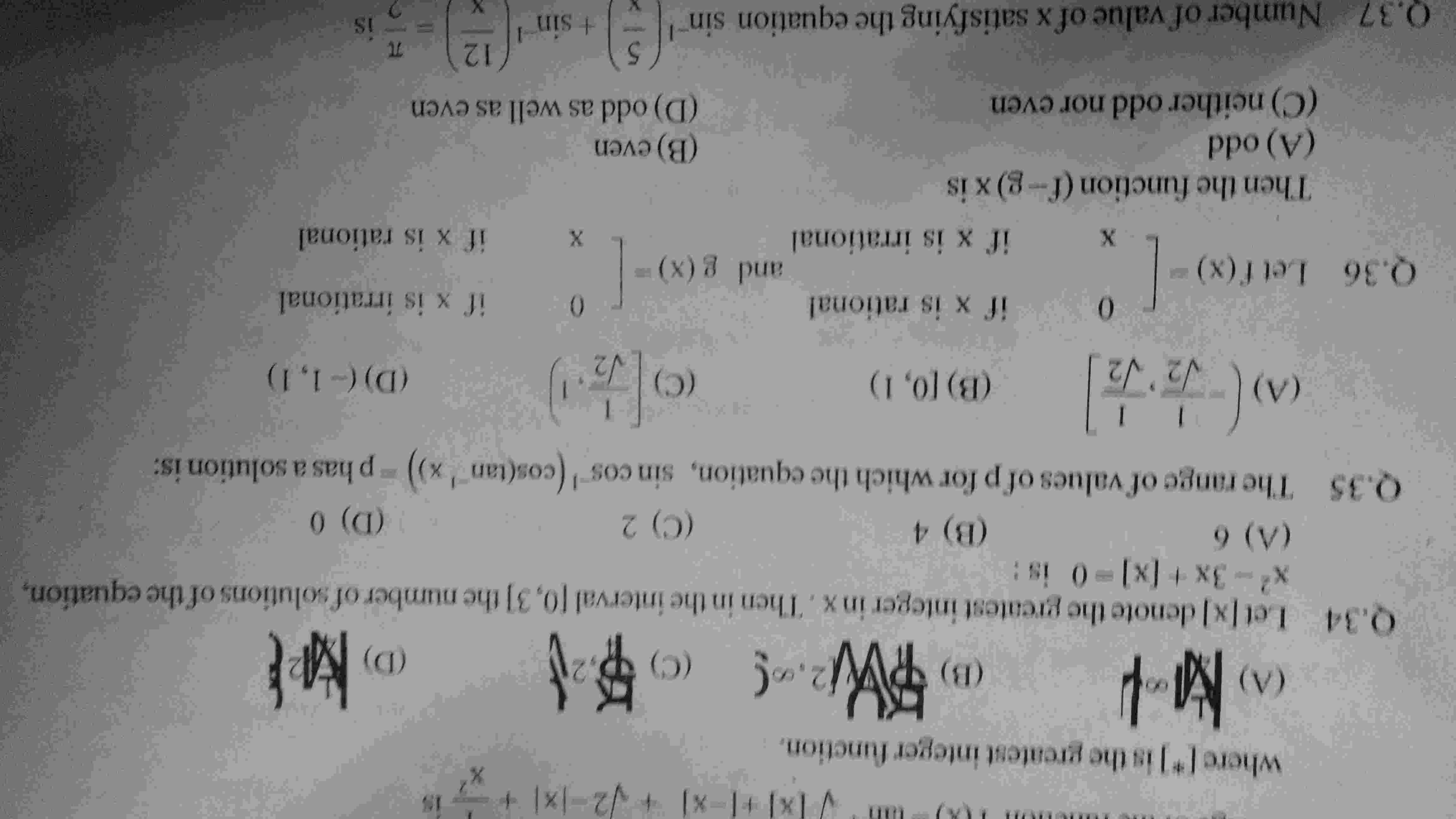
To analyze the function defined by \( (f - g)(x) \), we first need to understand the individual functions \( f(x) \) and \( g(x) \). The function \( f \) is defined such that \( f(x) = 0 \) when \( x \) is rational and \( f(x) = x \) when \( x \) is irrational. Conversely, the function \( g \) is defined as \( g(x) = 0 \) when \( x \) is irrational and \( g(x) = x \) when \( x \) is rational. Let's break this down step by step.
Understanding the Functions
We can summarize the definitions of \( f \) and \( g \) as follows:
- For \( f(x) \):
- If \( x \) is rational, then \( f(x) = 0 \).
- If \( x \) is irrational, then \( f(x) = x \).
- For \( g(x) \):
- If \( x \) is irrational, then \( g(x) = 0 \).
- If \( x \) is rational, then \( g(x) = x \).
Calculating \( (f - g)(x) \)
Now, let's compute \( (f - g)(x) \) for both rational and irrational values of \( x \).
Case 1: \( x \) is Rational
When \( x \) is rational:
- From \( f(x) \), we have \( f(x) = 0 \).
- From \( g(x) \), we have \( g(x) = x \).
Thus, we can calculate:
\( (f - g)(x) = f(x) - g(x) = 0 - x = -x \).
Case 2: \( x \) is Irrational
When \( x \) is irrational:
- From \( f(x) \), we have \( f(x) = x \).
- From \( g(x) \), we have \( g(x) = 0 \).
Therefore, we find:
\( (f - g)(x) = f(x) - g(x) = x - 0 = x \).
Final Result
Combining both cases, we can express \( (f - g)(x) \) as follows:
- If \( x \) is rational, then \( (f - g)(x) = -x \).
- If \( x \) is irrational, then \( (f - g)(x) = x \).
In summary, the function \( (f - g)(x) \) can be succinctly defined as:
\( (f - g)(x) = \begin{cases}
-x & \text{if } x \text{ is rational} \\
x & \text{if } x \text{ is irrational}
\end{cases} \)
This function exhibits interesting behavior based on the nature of the input \( x \), showcasing how rational and irrational numbers interact within the framework of these defined functions.