

Grade 12th passAlgebra
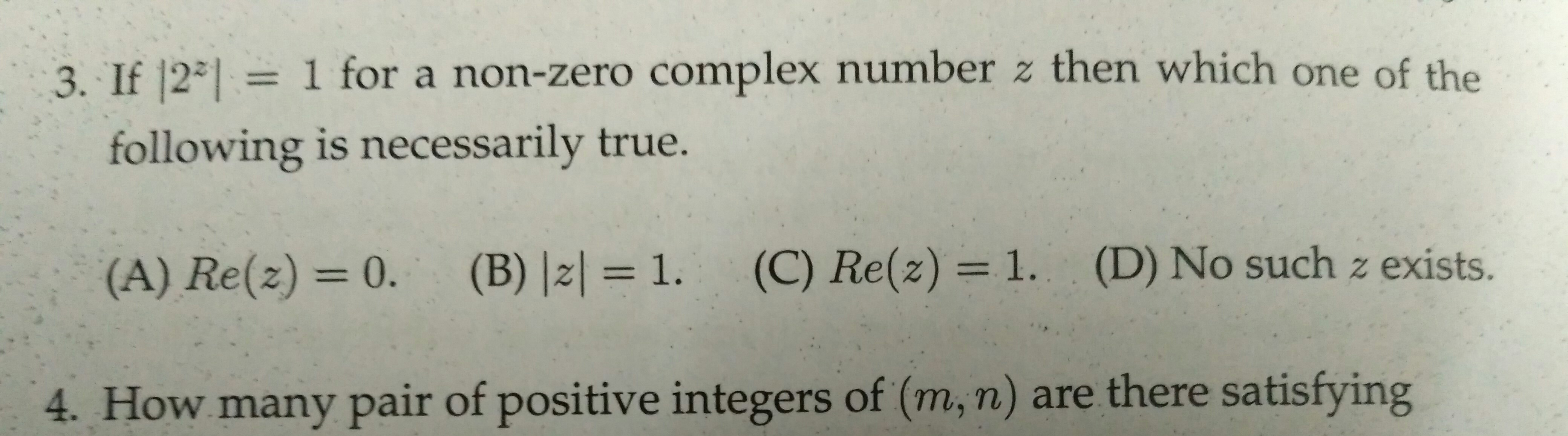
If mod2z=1 for a non zero complex number then which is necessarily true?


 Approved Tutor Answer1 Year ago
When we have a non-zero complex number \( z \) such that \( \text{mod} \, 2z = 1 \), we can derive some interesting properties about \( z \). The notation \( \text{mod} \, 2z \) typically refers to the modulus (or absolute value) of the complex number \( 2z \). So, we can express this mathematically as follows:
The modulus of a complex number \( z = a + bi \) (where \( a \) and \( b \) are real numbers, and \( i \) is the imaginary unit) is given by:
\( |z| = \sqrt{a^2 + b^2} \)
In our case, we need to find the modulus of \( 2z \):
\( |2z| = |2(a + bi)| = |2a + 2bi| = \sqrt{(2a)^2 + (2b)^2} = \sqrt{4a^2 + 4b^2} = 2\sqrt{a^2 + b^2} = 2|z| \)
Given that \( |2z| = 1 \), we can substitute this into our earlier expression:
\( 2|z| = 1 \)
From this equation, we can solve for \( |z| \):
\( |z| = \frac{1}{2} \)
Thus, we have established that if \( \text{mod} \, 2z = 1 \) for a non-zero complex number \( z \), it necessarily follows that:
This means that the distance of the complex number \( z \) from the origin in the complex plane is \( \frac{1}{2} \). This property is crucial in various applications, including signal processing and complex analysis, where understanding the magnitude of complex numbers plays a significant role.

Last Activity: 2 Years ago