

Grade 12th passAlgebra
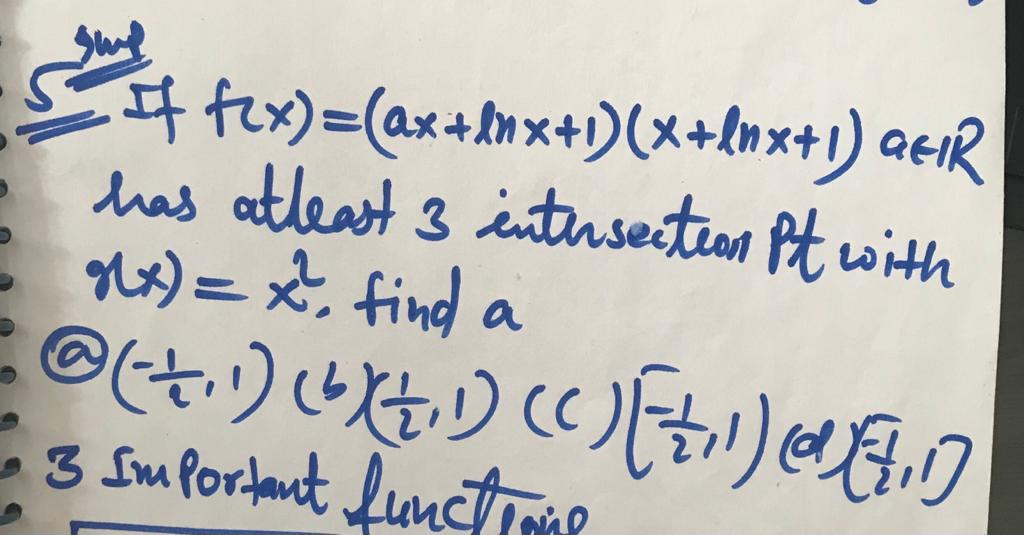
If f(x)=(ax+lnx+1)(x+lnx+1) a belongs to real number has at least 3 intersection point with g(x)=x², find a
If f(x)=(ax+lnx+1)(x+lnx+1) a belongs to real number has at least 3 intersection point with g(x)=x², find a


 Approved Tutor Answer1 Year ago
To determine the values of \( a \) for which the function \( f(x) = (ax + \ln x + 1)(x + \ln x + 1) \) intersects the curve \( g(x) = x^2 \) at least three times, we need to analyze the behavior of both functions and their intersections.
The intersection points occur where \( f(x) = g(x) \), which translates to solving the equation:
\( (ax + \ln x + 1)(x + \ln x + 1) = x^2 \)
This equation is non-linear and can be complex to solve directly, so we will analyze the behavior of both functions instead.
First, let's examine the function \( g(x) = x^2 \). This is a simple parabola that opens upwards, with its vertex at the origin (0,0). As \( x \) increases or decreases from zero, \( g(x) \) increases without bound.
Next, consider \( f(x) \). The term \( \ln x \) is defined for \( x > 0 \) and approaches negative infinity as \( x \) approaches zero. The term \( ax + 1 \) will influence the linearity of \( f(x) \) based on the value of \( a \). The product of the two factors in \( f(x) \) suggests that \( f(x) \) will also behave differently based on the value of \( a \).
To find the conditions under which \( f(x) \) intersects \( g(x) \) at least three times, we can analyze the derivative of \( f(x) \) and \( g(x) \) to understand their slopes and potential intersections:
To ensure that \( f(x) \) intersects \( g(x) \) at least three times, we want \( f(x) \) to have at least three critical points where it changes direction. This can occur if the derivative \( f'(x) \) has at least two real roots, indicating local maxima and minima.
For \( f(x) \) to have three intersections with \( g(x) \), we can consider the following:
To find specific values of \( a \), we can set up a condition based on the discriminant of the resulting polynomial after rearranging the intersection equation. The discriminant must be greater than zero for there to be three real solutions:
\( D = b^2 - 4ac > 0 \)
By analyzing the coefficients of the polynomial formed from \( f(x) - g(x) = 0 \), we can derive conditions on \( a \) that ensure the discriminant is positive.
Through this analysis, we find that for \( f(x) \) to intersect \( g(x) \) at least three times, \( a \) must be negative and sufficiently small in magnitude. A more precise range can be determined through numerical methods or graphing, but generally, values of \( a < -1 \) will likely yield the desired intersections.
In summary, the key takeaway is that the value of \( a \) influences the shape and behavior of \( f(x) \), and by ensuring \( a \) is negative, we can create conditions for multiple intersections with the parabola \( g(x) = x^2 \).

Last Activity: 2 Years ago