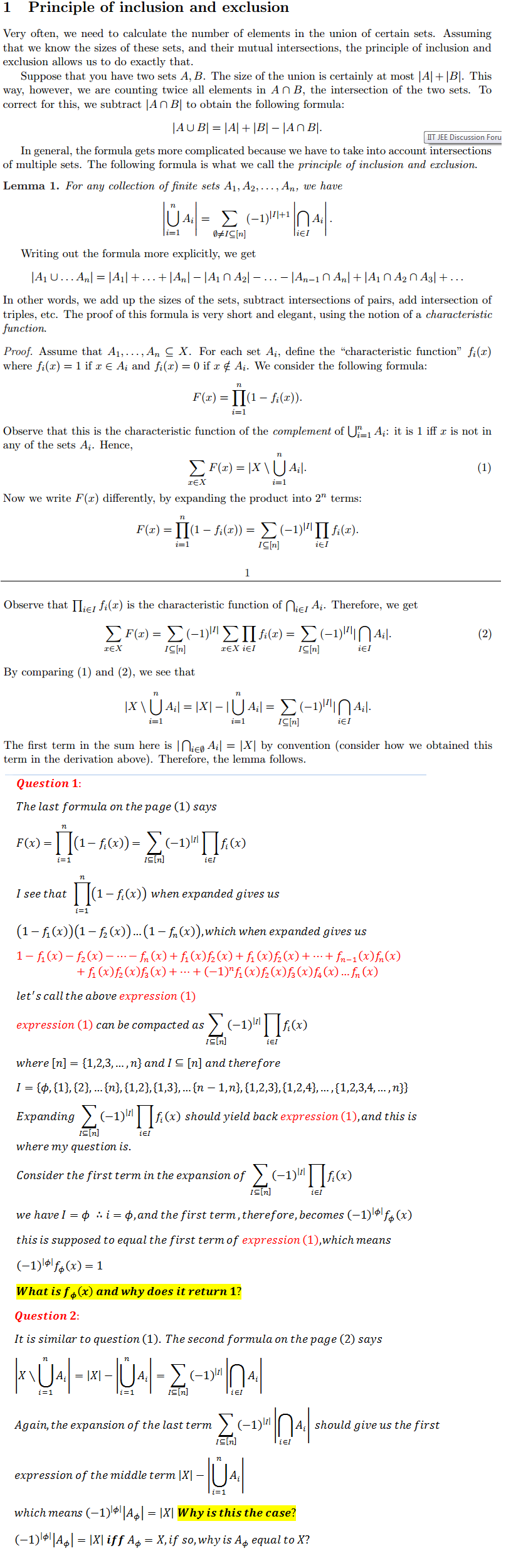
It sounds like you're delving into the principle of inclusion-exclusion (PIE), which is a fundamental concept in combinatorics and set theory. The use of characteristic functions in the proof is a powerful approach, as it allows us to represent sets and their relationships in a clear mathematical way. Let’s break down the principle and address your questions regarding the proof.
Understanding the Principle of Inclusion-Exclusion
The principle of inclusion-exclusion provides a way to calculate the size of the union of multiple sets. If you have several sets, the naive approach of simply adding their sizes will overcount the elements that are in multiple sets. PIE corrects this by systematically adding and subtracting the sizes of intersections of these sets.
Characteristic Functions Explained
A characteristic function, or indicator function, for a set A is defined as:
- 1 if an element is in the set A
- 0 if an element is not in the set A
For example, if we have a universal set U and a subset A, the characteristic function χA(x) can be expressed as:
χA(x) =
1 if x ∈ A,
0 if x ∉ A.
Applying Characteristic Functions to PIE
When proving the inclusion-exclusion principle using characteristic functions, we can express the size of the union of sets A1, A2, ..., An as follows:
The characteristic function for the union of these sets is:
χA1 ∪ A2 ∪ ... ∪ An(x) = max(χA1(x), χA2(x), ..., χAn(x)).
To find the size of the union, we can sum the characteristic functions and adjust for overlaps:
|A1 ∪ A2 ∪ ... ∪ An| = Σ|Ai| - Σ|Ai ∩ Aj| + Σ|Ai ∩ Aj ∩ Ak| - ... + (-1)n+1|A1 ∩ A2 ∩ ... ∩ An|.
Addressing Your Questions
Now, regarding your specific questions about the proof, while I can't see the image you mentioned, I can help clarify common points of confusion:
- Why do we alternate signs in the formula? The alternating signs account for the overcounting of elements that belong to multiple sets. By adding the sizes of intersections, we correct for the fact that these elements were counted multiple times.
- How do characteristic functions simplify the proof? Characteristic functions allow us to work with binary values (0 and 1), making it easier to manipulate and visualize the relationships between sets. This binary approach simplifies the counting process and helps in deriving the inclusion-exclusion formula more intuitively.
Feel free to ask more specific questions or clarify any points that might still be unclear. Understanding these concepts deeply will greatly enhance your grasp of combinatorial principles!