

Grade 12Algebra
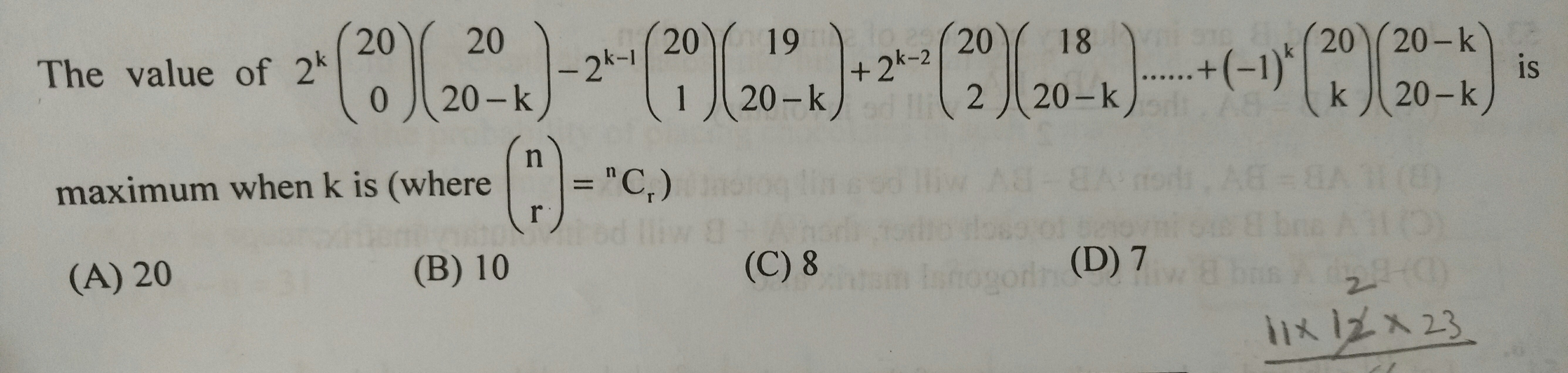
How to proceed after using swapping 20C20-k with 20Ck?
How to proceed after using swapping 20C20-k with 20Ck?


 Approved Tutor Answer0 Years ago
When you swap \( \binom{20}{20-k} \) with \( \binom{20}{k} \), you're utilizing a fundamental property of combinations known as the symmetry property. This property states that \( \binom{n}{r} = \binom{n}{n-r} \). In your case, you have \( n = 20 \) and \( r = k \), which means that \( \binom{20}{20-k} \) is equal to \( \binom{20}{k} \). This can simplify calculations in combinatorial problems significantly.
After recognizing that \( \binom{20}{20-k} = \binom{20}{k} \), you can proceed with your calculations or proofs more efficiently. This is particularly useful in problems involving binomial expansions or when calculating probabilities in combinatorial contexts.
Let’s say you are working on a problem that involves choosing a committee from a group of 20 people. If you need to find the number of ways to choose \( k \) members, you would calculate \( \binom{20}{k} \). However, if the problem also asks for the number of ways to leave out \( 20-k \) members, you would initially think to calculate \( \binom{20}{20-k} \). By applying the symmetry property, you can directly use \( \binom{20}{k} \) instead, streamlining your work.
This property not only saves time but also helps in understanding the relationships between different combinations. It reinforces the idea that choosing \( k \) members from a set is inherently linked to the number of ways to leave out \( 20-k \) members. This insight can be particularly valuable in more complex combinatorial problems or proofs.
In summary, after swapping \( \binom{20}{20-k} \) with \( \binom{20}{k} \), focus on how this simplification can aid your calculations. Always look for opportunities to apply such properties in combinatorial mathematics, as they can lead to more efficient problem-solving strategies.

Last Activity: 2 Years ago