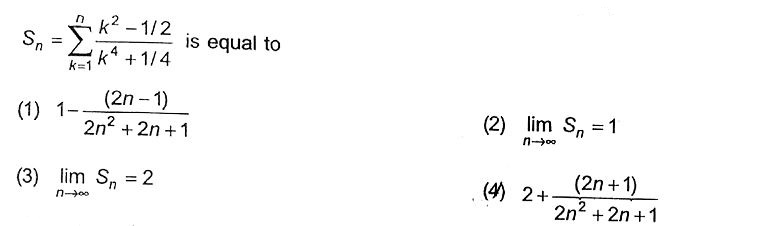
Hi Abhishek, it's great to hear that you're preparing for the IIT JEE! While I can't see the attached image, I'm here to help you with any question you have. Just describe the problem or topic you're struggling with, and I'll provide a detailed explanation to help you understand it better.
Breaking Down Complex Problems
When tackling questions, especially in subjects like physics or mathematics, it's essential to break them down into manageable parts. This approach not only clarifies your thought process but also helps you identify the underlying concepts involved.
Identifying Key Concepts
Start by identifying the main concepts related to your question. For instance, if it's a physics problem involving motion, consider the relevant equations of motion, forces, and any given data. If it's a math problem, look for the formulas or theorems that apply.
- Read the question carefully: Make sure you understand what is being asked.
- List known values: Write down all the given information.
- Determine what you need to find: Clarify your goal.
Applying the Right Techniques
Once you have a clear understanding of the concepts and the problem's requirements, apply the appropriate techniques. For example, if you're solving a quadratic equation, remember to use the quadratic formula or factorization methods as needed.
Example Scenario
Let’s say your question involves calculating the trajectory of a projectile. You would start by identifying the initial velocity, angle of projection, and acceleration due to gravity. From there, you can use the equations of motion to find the maximum height, range, and time of flight.
Step-by-Step Solution
1. **Identify Variables:** Let’s say the initial velocity (u) is 20 m/s, and the angle (θ) is 30 degrees.
2. **Break Down Components:** Calculate the horizontal (u_x) and vertical (u_y) components of the velocity using trigonometric functions:
- u_x = u * cos(θ)
- u_y = u * sin(θ)
3. **Use Equations of Motion:** Apply the equations to find the desired quantities, such as maximum height (H) using H = (u_y^2) / (2g), where g is the acceleration due to gravity.
Practice and Application
Finally, practice is key. Work through various problems to strengthen your understanding and application of concepts. The more you practice, the more comfortable you'll become with different types of questions.
Feel free to share the specifics of your question, and I’ll be happy to guide you through it! Good luck with your preparation!