Hello student,
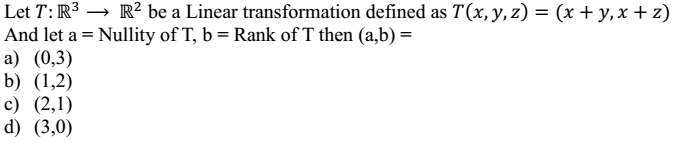
The given linear transformation is T(x, y, z) = (x+y, x+z).
We are required to find out the rank and nullity of T.
We know that if (x, y, z) ∈ N(T) (N(T) means nullity of T)
Then T(x, y, z) = 0.
Hence, we have (x+y, x+z) = (0,0)
Which gives x+y = 0 and x+z = 0
Solving this we get, y= z and x = -y.
N(T) = {(-y, y, y)| y∈ R } = L{(-1, 1, 1)}
So N(T) = 1.
Now, using the rank nullity theorem, we have R(T) + N(T) = dim R3
i.e. R(T) + 1 = 3.
This gievs R(T) = 2.
Hence, the correct option is (b)