Question icon
Grade 12Algebra

answer..................>>>>>>>>>>>>>>>>>>>>>>>>>>>>>>>>>>>>>>>>
Question image for answer..................>>>>>>>>>>>>>>>>>>>>>>>>>
Profile image of Soma Mesh
7 Years agoGrade 12
Answers icon

2 Answers

Profile image of Samyak Jain
7 Years ago
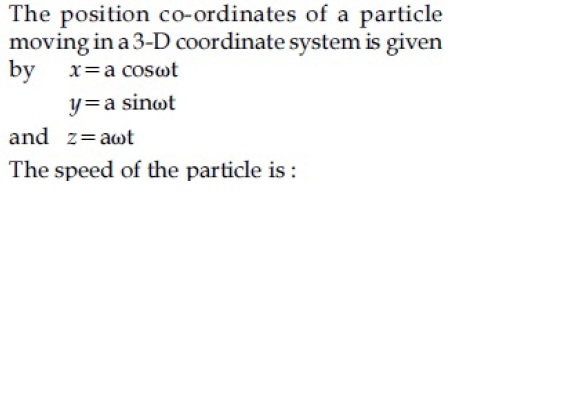
The particle is moving in a 3-D coordinate system.
Displacement in x-direction is given as x = a cos\omegat.
Differentiate both sides wrt t to get component of velocity in x-direction.
\Rightarrow vx = dx/dt = a(–sin\omegat) . \omega = – a\omegasin\omegat    [\because a is constant]
Similarly, y = a sin\omega\Rightarrow vy = dy/dt = a\omegacos\omegat
z = a\omega\Rightarrow  vz = dz/dt = a\omega
Speed of the particle v is the magnitude of the vector sum of the velocity components.
x,y and z axes are mutually perpendicular.
\therefore v = \sqrt{v_{x}^2 + v_{y}^2 + v_{z}^2} = \sqrt{(-a\omega sin\omega t)^2 + (a\omega cos\omega t)^2 + (a\omega)^2}
                                 = \sqrt{(a\omega)^2[sin^2 \omega t + cos^2\omega t + 1]} = a\omega\sqrt{1+1} = \sqrt{2} \omega
[\because sin2\omegat + cos2\omegat = 1]
Thus, the speed of the particle is \sqrt{2} \omega.
Profile image of Vikas TU
7 Years ago

If we differentiate the x,y,z co-ordinates wrt time we will get the velocity to be

-awsinwt, awcoswt , aw. So if we try to find the magnitude of this we will get the answer to be

1.732*aw as the speed.